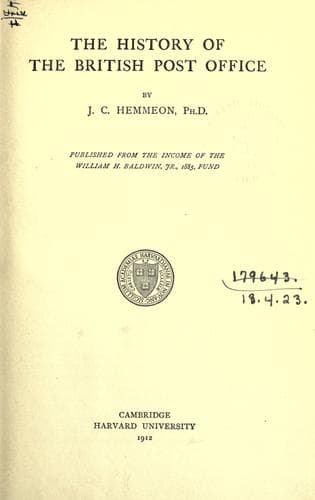
The History of the British Post OfficeHemmeon, Joseph Clarence
History
The History of the British Post Office
Hemmeon, Joseph Clarence
Postal service -- Great Britain -- History
After Dummer's failure, no attempt was made by the Post Office to revive
the service until 1745. In that year the Postmasters-General reported to
the Treasury in favour of regular packets between Falmouth and some port
in the West Indies. The report was agreed to, and orders were given for
two new boats to be supplied and for the two boats between Lisbon and
Gibraltar to be transferred there.[491] The agent at Falmouth was
ordered to see that each boat sailed with its full complement of men, as
the captains were accustomed to discharge some of the crew just before
sailing and pocket their wages. He was also to make sure that each of
the boats sailing from Falmouth for Lisbon, the West Indies, or North
America was British built and navigated by British seamen. He must keep
a journal, in which should be entered the time that he received and
delivered mails and expresses, how the wind and tide served, when the
boats arrived and departed, and any delay in sailing which might occur.
The captains were ordered to make returns after each voyage of the
number of men on board. The crew while on shore should receive their
accustomed wages and "victuals" and, if any were discharged, a return
was to be made of such discharge, the money due them being turned over
to the pension fund. It had become customary for the captains not to pay
the men while they were on shore and to retain the money owing them.
Finally the agent was to see that the packet boats proceeded to the
Roads the day before the mail was expected from London.[492] Packets had
already been employed to convey mails to and from Madeira and
Brazil[493] and within the next few years others were hired to ply
between Falmouth, Buenos Ayres,[494] Colombia, Mexico, San Domingo, and
Cuba, and between the British West Indies, Colombia, and Mexico.[495]
[491] _Cal. T. B. and P._, 1742-45, pp. 705, 707.
[492] _Jo. H. C._, 1787, pp. 816, 817.
[493] 48 Geo. III, c. 116.
[494] 5 Geo. IV, c. 10.
[495] 6 Geo. IV, c. 44.
In 1815, the Postmaster-General was given permission by Act of
Parliament to establish sailing packets between the United Kingdom, the
Cape of Good Hope, Mauritius, and that part of the East Indies embraced
within the charter of the East India Company. Packet rates were also
charged for letters carried by war vessels and by vessels of the
company, but in the former case the consent of the Lords of the
Admiralty for the use of their ships had first to be obtained. Letters
to and from China must go by vessels of the company and no others. With
the consent of the Commissioners of the Treasury or any three of them,
the Postmaster-General might allow the regular sailing packets to import
and export all goods, which might legally be imported or exported, but
in the case of tea, only enough for the use of those on board should be
carried.[496]
[496] 55 Geo. III, c. 153.
When Cotton and Frankland were appointed Postmasters-General in 1691,
the following sailing packets were in commission.[497]
Public-domain text, read in full here on John Shaqi.
Reviews
Reviews
No reviews yet
Be the first to share your thoughts on this work.
Elsewhere in the archive
Join the Discussion
Join the discussion
Sign in to leave a comment or review.
Sign InorCreate an account