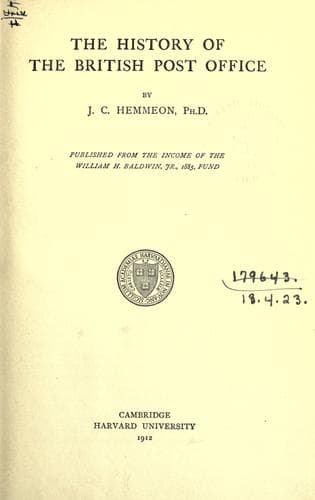
The History of the British Post OfficeHemmeon, Joseph Clarence
History
The History of the British Post Office
Hemmeon, Joseph Clarence
Postal service -- Great Britain -- History
The Post Office was at no time entirely dependent upon its regular
sailing packets for the carriage of the mails. The merchant marine of
England had been increasing with her growing commerce, and provision was
made in the acts of 1657 and 1660 for the carriages of letters by
private vessels. By the latter of these acts the conveyance of letters
to foreign countries had been restricted to English ships under a
penalty of £100 for every offence. It was decided in 1671, on the
occasion of the wreck of one of the regular Irish packets, that it would
be better to use a Dutch-built ship on account of its being much more
seaworthy in the choppy swell of the Irish sea. Accordingly an
order-in-council was issued, allowing a vessel built in Holland to be
used, and providing for its naturalization.[517] By the act of 1660,
letters arriving in private vessels were to be given to the postmaster
at the port of arrival so that they might be forwarded to London to be
despatched to their destination after being charged with the postage
due. Masters of vessels were offered no inducement to deliver the
letters to the postmaster nor was any liability incurred by neglecting
to do so. The post farmers, however, agreed to pay a penny for every
letter delivered by a captain on his arrival. This was the origin of
ship letter money.[518]
[517] _Cal. S. P. D._, 1671, p. 203. In 1793, owing to a scarcity of
English vessels and as a war measure, permission was given to send
English letters to Spain and Portugal by means of Spanish ships (33 Geo.
III, c. 60).
[518] Joyce, p. 73.
No attempt had ever been made to collect postage on letters conveyed by
private ships except for the distance which such letters might be
carried by the regular posts within the kingdom.[519] In 1799 an act was
passed under the following title: "An Act for the more sure conveyance
of ship letters and for granting to His Majesty certain rates of postage
thereon." The Postmasters-General were given authority by this act to
forward letters and packages by other vessels than the sailing packets.
On letters brought in by such vessels, 4_d._ was to be charged for a
single letter and so in proportion. This was to be in addition to the
inland postage and 2_d._ was to be paid to the master for every letter
handed over by him to the Post Office. The net revenue so arising was to
be paid into the Exchequer. No postage was charged on letters carried
out of the kingdom by private vessels[520] until 1832, when permission
was given to charge packet rates. It was forbidden to send letters by
these ships except through the Post Office unless such letters concerned
only the goods on board.[521] In 1835 that part of the act of 1711
forbidding letters to be sent out of the kingdom except in British ships
was repealed.[522]
[519] It is true that by the act of 1711, a penny was to be charged for
every ship letter; but this was to go to the master of the ship.
[520] 39 Geo. III, c. 76.
[521] 2 Wm. IV, c. 15.
Public-domain text, read in full here on John Shaqi.
Reviews
Reviews
No reviews yet
Be the first to share your thoughts on this work.
Elsewhere in the archive
Join the Discussion
Join the discussion
Sign in to leave a comment or review.
Sign InorCreate an account