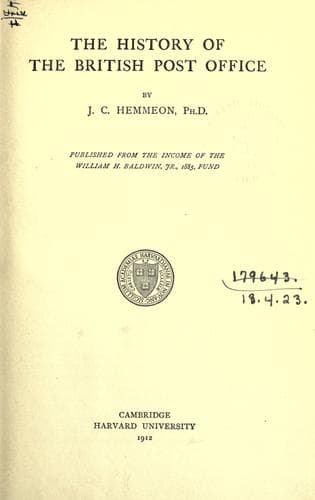
The History of the British Post OfficeHemmeon, Joseph Clarence
History
The History of the British Post Office
Hemmeon, Joseph Clarence
Postal service -- Great Britain -- History
[522] 5 and 6 Wm. IV, c. 25.
The sailing packets were ordinarily allowed to carry passengers and
freight, for which fixed rates were charged. In case of trouble with
any foreign power, the masters were generally forbidden to allow their
packets to be used as passenger boats.[523] During King William's war,
the Harwich-Helvoetsluys packets carried recruits free to the scene of
activities.[524] They had also been guilty of bringing dutiable goods
into the country and paying no duty on them. This made the customs
officials indignant, especially as the Post Office authorities would not
allow them to search the packets on their arrival. By an act passed in
1662, no ship, vessel, or boat ordinarily employed for the carriage of
letters was allowed to import or export any goods, unless permission had
been given by the customs officials, under a penalty of £100 to be paid
by the master of the offending packet boat.[525] It had been agreed
between Dummer and the Post Office that he should carry no more than
five tons of merchandise outward bound nor more than ten tons when
homeward bound. The Commissioners of the Customs in 1708 advised the
Lord High Treasurer that if he gave licences to the packet boats to
carry goods[526] it would be necessary to comply with the law and
subject the boats to searchers, rules, and penalties as the merchantmen
were. They proposed that the agreement made with Dummer be applied to
all the packets. They pointed out that if this were done, all friction
between the customs and Post Office might be avoided.[527] In 1732, the
difficulty assumed a new form over the question as to the carriage of
dutiable goods by mail. Diamonds had recently been discovered in Brazil
and they were exported to England via Spain. It had also become
customary to send fine laces by post. We, who have become used to
intolerant customs' regulations, can hardly appreciate the indignation
aroused by the desire of the customs' authorities to search the mails.
It was the rule at that time for the Controller of the Foreign Office to
lay a tax of 1 per cent upon packages which he thought had lace or
diamonds in them. The customs officials seized twenty-one parcels of
diamonds in a mail bag, coming from Lisbon in the packet _Hanover_. The
Postmasters-General were very indignant and wrote to the Treasury that
they "would not have it left to a customs' house officer to break open
the King's mail, which has never been done before."[528] Evidently the
customs officials had exceeded their authority and the matter was
compromised by the appointment of a sub-controller of the Foreign Post
Office to act under the authority of the Customs Commissioners and
receive the duties on diamonds and other jewels and precious stones
imported in the packet boats.[529] In a report of the
Postmasters-General somewhat earlier, we are informed of a payment of
£1087 made by them to the Receiver-General of the Customs. This amount
Public-domain text, read in full here on John Shaqi.
Reviews
Reviews
No reviews yet
Be the first to share your thoughts on this work.
Elsewhere in the archive
Join the Discussion
Join the discussion
Sign in to leave a comment or review.
Sign InorCreate an account