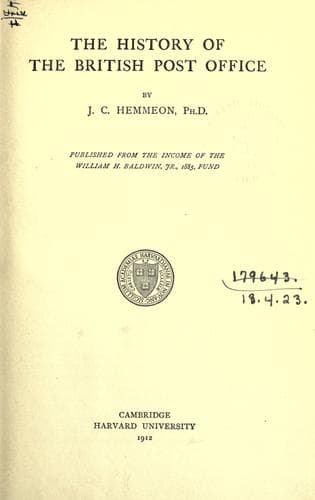
The History of the British Post OfficeHemmeon, Joseph Clarence
History
The History of the British Post Office
Hemmeon, Joseph Clarence
Postal service -- Great Britain -- History
[537] _Ibid._, 1787, pp. 815-16. Anthony Todd, Secretary of the Post
Office, writing to Charles Cox in Harwich said that "several persons
going from Helvoetsluys to Harwich, who are well able to pay full fare,
have given money for half, free and poor passes, and larger sums have
been taken for passes than are allowed by the Postmaster-General" (_Jo.
H. C._, 1787, p. 805).
[538] _Ibid._, 1787, p. 205.
The result of these exposures was a series of reforms started in 1793.
By 1797 the Post Office was able to report that orders had been issued
forbidding any official to own a sailing packet or have a share in any
of them. Orders were given to pay the sailors regularly throughout the
whole year. The 2-1/2 per cent on all expenditure, formerly paid to the
Secretary, was abolished. Finally all salaries were henceforth to be in
lieu of every emolument.[539]
[539] _Fin. Rep._, 1797, no. 7, pp. 52-65.
In 1793, the expenses for packet boats amounted to £45,666 a year. This
was reduced in the following year to £36,940, but from 1795 expenses
began to increase, owing to losses during the war and the necessity for
placing the boats on a war footing.[540] In time of peace, a Falmouth
packet of 179 tons carried twenty-one men, including officers, at a
total expenditure for men, interest, insurance, and wear and tear, of
£1681.[541] In time of war, she carried twenty-eight men, all of whom
were paid higher wages, and other expenses were also higher, bringing
the total expenses for each packet to £2112 a year.[542] For a packet of
seventy tons the expenses during peace and war were respectively £536
and £862.[543] It is not surprising then that the cost for all the
packet boats had risen in 1796 to £77,599. The Falmouth boats were
responsible for £60,444 of this, the rest being divided amongst the
Dover, Harwich, Donaghadee, Milford, Weymouth, and Holyhead packets and
the West India schooners.[544] The salaries paid to the agents in 1796
amounted to £3412. They were stationed at Lisbon, Falmouth, Yarmouth
(instead of Harwich and Dover), Weymouth, Jamaica, Halifax, N. S., and
Quebec. In Lisbon and the colonial towns, the agents acted also as
postmasters.[545]
[540] _Ibid._, no. 7, p. 131.
[541] _Fin. Rep._, no. 7, p. 119.
[542] _Ibid._, no. 7, p. 118.
[543] _Ibid._, no. 7, pp. 122-23.
[544] _Ibid._, no. 7, p. 117.
[545] _Ibid._, no. 7, p. 116.
In 1827, all the packets sailing out of Falmouth were transferred to the
Admiralty, in spite of Freeling's protest. The question had been
discussed again and again during the war with France but why it was
decided upon at this particular time is not clear. At the time of
transfer, thirty packets were employed at Falmouth, carrying mails to
and from Lisbon, Brazil, Buenos Ayres, the Mediterranean, America, the
Leeward Isles, Jamaica, Colombia, and Mexico. In 1828, the number of
packets at Falmouth had increased to thirty-eight brigs of war and
sailing vessels and in 1833 to forty-one.[546]
Public-domain text, read in full here on John Shaqi.
Reviews
Reviews
No reviews yet
Be the first to share your thoughts on this work.
Elsewhere in the archive
Join the Discussion
Join the discussion
Sign in to leave a comment or review.
Sign InorCreate an account