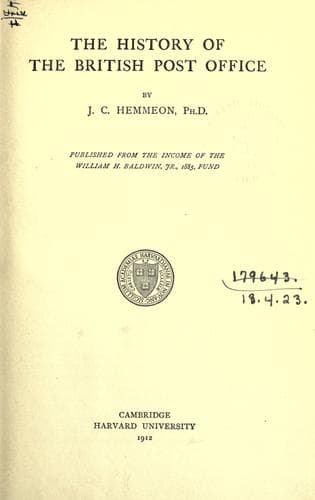
The History of the British Post OfficeHemmeon, Joseph Clarence
History
The History of the British Post Office
Hemmeon, Joseph Clarence
Postal service -- Great Britain -- History
The postal abuses which came to light in 1787 were more flagrant in
connection with the packet service than in any other department of the
Post Office. The Secretary himself was not only a large owner in the
boats, but as agent he received 2-1/2 per cent of the gross total
expenditure. From 1770 to 1787, this had amounted to £1,038,133, from
which he had received over £25,000. Besides this, his salary amounted to
£1000 a year and there was an annuity of £100 attached to his office. He
had become too old to perform his duties, but instead of being
superannuated another person was appointed to assist him.[534]
[534] _Fin. Rep._, 1797, no. 7, p. 5.
The Sailors' Pension Fund was grossly mismanaged. Each sailor's monthly
contribution had been raised from 10_d._ to 2_s._ and then 3_s._ After
twenty years' service, the man who had kept up his payments was entitled
to receive £4 or £5 a year. The names of dead people were retained on
the list of pensioners, fictitious names were added, and there seems no
doubt that the agent retained the money ostensibly paid out in their
names.[535] The agent at Falmouth had a salary of £230 a year and £160
in perquisites, £100 of which were paid to the former agent's widow. The
late agent had received £430 a year in perquisites in addition to the
regular £390 less £40 for a clerk and an assistant postmaster, making
£780 in all, certainly a comfortable salary for a packet agent at that
time. The £430 was made up by an involuntary contribution of five
guineas from each of the captains of the twenty-two packet boats and the
wages of one man from each boat. The latter sum was obtained by
dismissing the men, whose wages still continued to be paid--to the
agent. Smuggling had become by no means uncommon among the Falmouth
boats, the carriage of the mails being considered of secondary
importance. They often arrived when least expected, or they might not
arrive for days at a time, although the wind and weather were
favourable.[536]
[535] _Jo. H. C._, 1787, p. 116.
[536] _Jo. H. C._, 1787, pp. 815-16.
Fares for passengers were not always collected, but a moderate payment
to the captains would ensure a passage as they were allowed to carry
their friends free and the payment readily secured the privilege
desired. The agents also profited by the sale of passes.[537] There were
more boats on the Falmouth station than necessary, and, although they
ranged in size from 150 to 300 tons, the same number of men were
employed on each. The Secretary of the Post Office, from whose report
these facts about the packets are derived, proposed that three or four
of the boats should be taken off, thus effecting a saving of £6000 or
£8000. In case it should be considered expedient to employ regular
packet boats to Quebec and Halifax, N. S., they might be placed on those
stations. No deductions were made for the hire of boats when they were
unemployed, either when being repaired or when under seizure for
smuggling.[538]
Public-domain text, read in full here on John Shaqi.
Reviews
Reviews
No reviews yet
Be the first to share your thoughts on this work.
Elsewhere in the archive
Join the Discussion
Join the discussion
Sign in to leave a comment or review.
Sign InorCreate an account