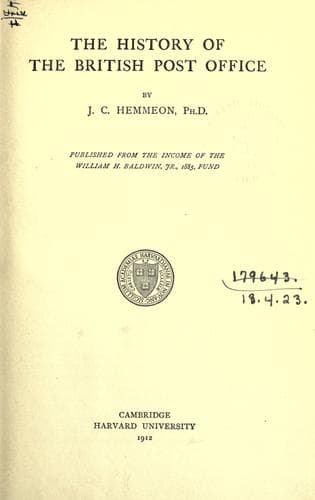
The History of the British Post OfficeHemmeon, Joseph Clarence
History
The History of the British Post Office
Hemmeon, Joseph Clarence
Postal service -- Great Britain -- History
_For a_ _Double_ _Per_
_single letter_ _letter_ _ounce_
To Leghorn, Genoa, Florence, Lyons,
Marseilles, Aleppo, Constantinople 12_d._ 24_d._ 45_d._
To St. Malo, Morlaix, Nieuhaven 6 12 18
To Bordeaux, Rochelle, Nantes,
Bayonne, Cadiz, Madrid 9 18 24
To Hamburg, Frankfort, and Cologne 8 16 24
To Dantzic, Leipsic, Lubeck,
Stockholm, Copenhagen, Elsinore,
Konigsburg 12 24 48[571]
[571] Scobell, _Collect._, pt. ii, pp. 511-13. Inland letters containing
more than two enclosures but weighing less than an ounce were charged
according to the number of enclosures.
These rates are considerably lower than those of Witherings and are
essentially the same as those of 1653, except that the postage is fixed
for letters to and from the continent. No provision is made for letters
to and from any other part of the world but Europe. Since the government
had not established any postal communication with Asia, Africa, or the
Americas, it would have been unfair to demand postage on letters
conveyed by merchant vessels to and from those places.[572]
[572] Scobell, _Collect._, pt. ii, pp. 511-13.
The act of 1660 is generally referred to as bringing the Post Office
under Parliamentary control and as the basis of the modern system. This
is probably due to the fact that the act of 1657 was passed by a
Commonwealth Parliament and signed by Cromwell. Whether its authors
lacked the power to give it validity, they did not lack the brains to
pass an excellent act, and although the Royalists saw fit, after the
Restoration, to dub it the pretended act of 1657, they could not improve
it and had the sense to leave it largely untouched. The first act had
imposed rates from or to any place to or from London as a centre. It had
been taken for granted that all letters passed to, from, or through the
capital, and to all intents and purposes this was so. It was possible,
however, for letters, technically called bye-letters, to stop short of
London, and it was to provide for these that postage was to be reckoned
from any place where a letter might be posted.
Public-domain text, read in full here on John Shaqi.
Reviews
Reviews
No reviews yet
Be the first to share your thoughts on this work.
Elsewhere in the archive
Join the Discussion
Join the discussion
Sign in to leave a comment or review.
Sign InorCreate an account