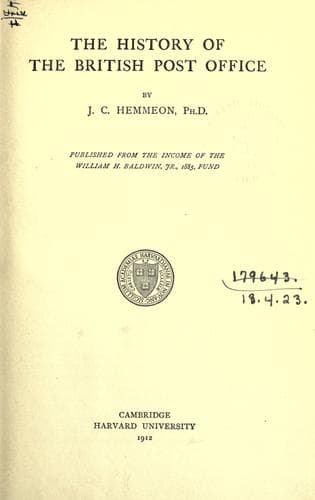
The History of the British Post OfficeHemmeon, Joseph Clarence
History
The History of the British Post Office
Hemmeon, Joseph Clarence
Postal service -- Great Britain -- History
Scotland was no longer a part of England after the Restoration, so that
by the act of 1660 rates were given to and from Berwick and for single
letters were a penny less than they had been to Scotland under the
earlier act. From Berwick the rate, within a radius of forty miles, was
2_d._ for a single letter, and over forty miles, 4_d._ As far as foreign
postage was concerned, letters to the northern coast towns of Italy paid
3_d._ less than the old rate for a single letter. Other rates remained
the same. Alternative routes were sometimes offered. For instance,
letters might be sent directly to northern Italy or they might go via
Lyons, but in the latter case they cost 3_d._ more. Again, there were
many more continental towns to which letters might be sent and from
which they might be received. Letters for Germany via Hamburg had to be
postpaid as far as that city. The same was true of letters to southern
France via Paris and of letters to northern Italy via Lyons. The highest
rate paid for a single letter was 1_s._ to northern Italy, Turkey, and
central and northern Germany. Merchants' accounts not exceeding one
sheet of paper, bills of exchange, invoices and bills of lading, were to
pay nothing over the charge of the letter in which they might be
enclosed. The same rule was to hold for the covers of letters sent to
Turkey via Marseilles. All inland letters were to be paid for at the
place where they were delivered unless the sender wished to pay in
advance.[573]
[573] 12 Chas. II, c. 35.
When the Scotch was separated from the English Post Office in 1695,
rates were imposed by the Parliament of Scotland as follows:
_For a single letter_
To Berwick 2_s._[574]
Within 50 miles from Edinburgh 2
From 50 to 100 miles from Edinburgh 3
Above 100 miles from Edinburgh 4
Packages of papers were to pass as triple letters.[575] In 1701, when
the Scotch Post was let out to farm, the English Postmasters-General
advised that the farmers should be obliged to pay at Berwick the postage
on English and foreign letters for Scotland, and an order in accordance
with this advice was signed by the King. It was the custom to change the
farmers every three years, which may have produced a larger revenue but
was certainly not calculated to increase the efficiency of the office.
The English Postmasters-General had great difficulty in collecting at
Berwick the postage due them, and it is doubtful whether a large part
was ever paid. The frequent changes in the farmers must have been an
excellent means of allowing them to escape their debts to the
English.[576]
[574] One shilling Scotch was equal to one penny English.
[575] Wm. III, 1st parl., 5th session (Scotland), c. 31.
[576] _Cal. T. P._, 1697-1702, 48; 1702-1707, 101.
Public-domain text, read in full here on John Shaqi.
Reviews
Reviews
No reviews yet
Be the first to share your thoughts on this work.
Elsewhere in the archive
Join the Discussion
Join the discussion
Sign in to leave a comment or review.
Sign InorCreate an account