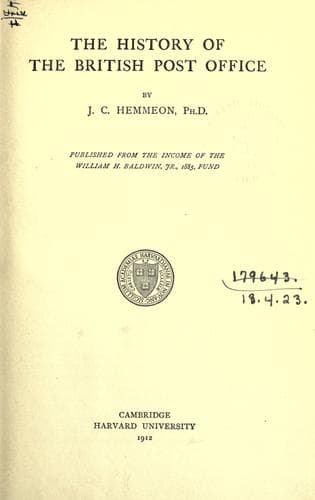
The History of the British Post OfficeHemmeon, Joseph Clarence
History
The History of the British Post Office
Hemmeon, Joseph Clarence
Postal service -- Great Britain -- History
The act of 1711 in prescribing the rate of postage for the carriage of
"every single letter or piece of paper" enacted that a "double letter
should pay twice that rate." The merchants contended that a double
letter was composed of two sheets of paper if they weighed less than an
ounce and their reasoning was logical. They argued from this that a
letter enclosing a pattern or patterns, if it weighed less than one
ounce, should pay only as a single letter. Actions were brought against
the postmasters by the merchants for charging more than they considered
was warranted and the merchants won every case. The lawyers also
threatened legal proceedings for the charge of writs when enclosed in
letters. The Postmasters-General hastened to Parliament for relief. The
merchants heard of this, and petitions were sent to the House of Commons
from "clothiers, dealers in cloth, silk, and other manufactured goods,"
asking that when samples were enclosed in a single letter the rate
should remain the same provided that such letter and sample did not
exceed half an ounce in weight.[586] Their efforts were fruitless. The
following provisions were inserted in a tobacco bill then before
Parliament and passed in 1753: "that every writ etc. enclosed in a
letter was to pay as a distinct letter and that a letter with one or
more patterns enclosed and not exceeding one ounce in weight was to pay
as a double letter."[587] As a matter of fact all the rates collected
after 1743 by virtue of the act of 1711 were illegal, for the act itself
had died a natural death in the former year by that clause which
provided for the revival of the rates of 1660 at the end of thirty-two
years.
[586] _Jo. H. C._, 1745-50, pp. 751-2.
[587] 26 Geo. III, c. 13, secs. 7, 8.
A postal act was passed in 1765, slightly changing the home, colonial,
and foreign rates. The cession of territory in North America had made
necessary a more comprehensive scheme of postage rates there. The
conclusion of the Seven Years' War had made it possible to offer a
slight reduction in postage. In Great Britain the following rates were
published for short distances for a single letter:--
For Great Britain--not exceeding one post stage 1_d._
For England alone--over one and not exceeding two stages 2_d._
The rates for all other distances remained unchanged. A stage, as a
rule, varied from ten to twelve miles in length, so that every post town
in England could now boast a modified form of penny postage, with the
exception in most cases of delivery facilities.
Public-domain text, read in full here on John Shaqi.
Reviews
Reviews
No reviews yet
Be the first to share your thoughts on this work.
Elsewhere in the archive
Join the Discussion
Join the discussion
Sign in to leave a comment or review.
Sign InorCreate an account