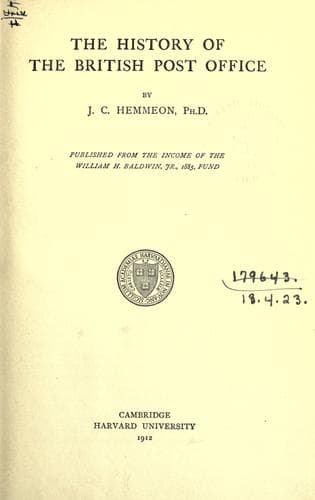
The History of the British Post OfficeHemmeon, Joseph Clarence
History
The History of the British Post Office
Hemmeon, Joseph Clarence
Postal service -- Great Britain -- History
The changes in colonial rates were generally in the shape of
substituting general for special rules. The rate from any part of the
British American Dominions to any other part was fixed at 4_d._ for a
single letter when conveyed by sea. The act of 1711 had given the
postage from and to specially named places. This method had become
inapplicable with the growth in population among the old and the
increase in new possessions. The rate for a single letter from any chief
post office in the British American Dominions to a distance not
exceeding sixty miles, or for any distance not exceeding sixty miles
from any post office from which letters did not pass through a chief
post office, was placed at 4_d._, from sixty to 100 miles 6_d._, from
100 to 200 miles 8_d._, for each additional hundred miles 2_d._ The
effect of this act was to continue the same rates for inland postage in
British America, while rates were provided for distances over 100 miles.
The postage between England and the American colonies remained at 12_d._
for a single letter. In the case of the West Indies, there was a
decrease of 6_d._ A clause of the act provided that the postage on
letters sent out of England might be demanded in advance.[588]
[588] 5 Geo. III, c. 25. The principle of payment in advance was not
popular. A man in England writing to his brother in Virginia in 1764
says, "Very often of late I have been so foolish, I should say
unfortunate previously to pay for the letters coming to you.... To my
great concern I have been since assured that such letters never go
forward but are immediately thrown aside and neglected. I believe I
wrote to you three or four times this last winter by this method and am
since informed of this their fate. You may form a great guess of the
truth of it by or by not receiving them" (_Notes and Queries_, 4th ser.,
xii, p. 125).
Postage rates were increased steadily from 1784 for twenty-eight years,
culminating in the year 1812 with the highest rates that England has
ever seen. Every available means to raise the revenue necessary to
maintain her supremacy was resorted to, and the Post Office was
compelled to bear its share of the burden. In 1784 another penny was
added to the rates for single letters and additional rates for double
and triple letters in proportion.[589] Three years later an act was
passed, fixing the postage for the conveyance of a single letter by
sailing packet from Milford Haven to Waterford at 6_d._ over and above
all other rates. It was provided by the same act that the rates between
London and Ireland via Milford should not exceed the rates via
Holyhead.[590]
[589] 24 Geo. III, sess. 2, c. 37.
[590] 27 Geo. III, c. 9. In 1767 a rate of 2_d._ for a single letter was
established between Whitehaven (Cumberland) and the Port of Douglas
(Isle of Man) (7 Geo. III, c. 50).
Public-domain text, read in full here on John Shaqi.
Reviews
Reviews
No reviews yet
Be the first to share your thoughts on this work.
Elsewhere in the archive
Join the Discussion
Join the discussion
Sign in to leave a comment or review.
Sign InorCreate an account