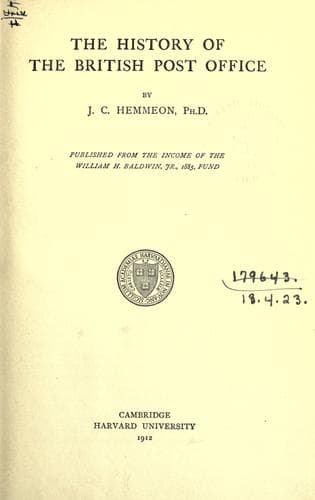
The History of the British Post OfficeHemmeon, Joseph Clarence
History
The History of the British Post Office
Hemmeon, Joseph Clarence
Postal service -- Great Britain -- History
In 1814 the postage on a single letter brought into the kingdom by
ships other than the regular packets was raised from 4_d._ to 6_d._ in
addition to the regular inland rates. The rate for letters sent out of
the kingdom by these vessels was fixed at one third the regular packet
rates.[606] An exception was made in the case of letters carried by war
vessels or by vessels of the East India Company to and from the Cape of
Good Hope, Mauritius, and that part of the East Indies embraced in the
charter of the company. The rates by these vessels were to be the same
as the regular packet rates, 42_d._ for a single letter between those
places and England, and 21_d._ for a single letter between the places
themselves. Newspapers were charged 3_d._ an ounce between England, the
Cape, Mauritius, and the East Indies. The rate for a single letter
conveyed in private vessels not employed by the Post Office to carry
mails was 14_d._ from England to the Cape or the East Indies, and 8_d._
from the Cape or the East Indies to England. The company was allowed to
collect rates on letters within its own territory in India, but the
Postmasters-General of England might at any time establish post offices
in any such territory. The company was to be paid for the use of its
ships in conveying letters.[607]
[606] 54 Geo. III, c. 169. Enacted for Ireland the following year (55
Geo. III, c. 103).
[607] 55 Geo. III, c. 153. This act, although repealed for Great Britain
by 59 Geo. III, c. 111, still remained in force in Ireland (5 and 6 Wm.
IV, c. 25).
Public-domain text, read in full here on John Shaqi.
Reviews
Reviews
No reviews yet
Be the first to share your thoughts on this work.
Elsewhere in the archive
Join the Discussion
Join the discussion
Sign in to leave a comment or review.
Sign InorCreate an account