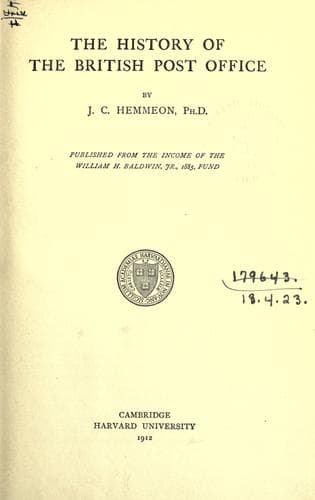
The History of the British Post OfficeHemmeon, Joseph Clarence
History
The History of the British Post Office
Hemmeon, Joseph Clarence
Postal service -- Great Britain -- History
By the Ship Letter Act of 1814, no letters were to be sent by private
ships except such as had been brought to the Post Office to be charged.
The directors of the East India Company had protested against this
section of the act. It is true that they were allowed to send and
receive letters by the ships of their own company, but in India there
was a small army of officials in their service whose letters had
hitherto gone free. For that matter it had been the custom for the
company to carry for nothing all letters and papers which were placed in
the letter box at the East India House.[608] Petitions were presented
against an attempt on the part of the Post Office to charge postage on
letters to and from India when conveyed by private vessels.[609] The
company refused to allow its vessels to be used as packet boats or even
to carry letters at all. It was in consequence of all this opposition
that the act of 1815 was passed, giving more favourable treatment to
letters to and from India. By this act no person sending a letter to
India was compelled to have it charged at the Post Office and the
masters were compelled to carry letters if the Postmasters-General
ordered them. The company now withdrew all opposition and even refused
to accept any payment for the use of their vessels in conveying
letters.[610] Notwithstanding the favourable exception made in the case
of letters to and from the East Indies, there was still discontent over
the high rates charged by the Post Office for the conveyance of letters
by the regular packet boats and by private vessels, when carrying
letters entrusted to the Post Office.[611] In 1819 the sea postage on
any letter or package not exceeding three ounces in weight from Ceylon,
Mauritius, the Cape, and the East Indies was placed at 4_d._ If it
exceeded three ounces in weight, it was charged 12_d._ an ounce. The sea
postage on letters and packages to Ceylon, etc., not exceeding three
ounces in weight, was placed at 2_d._ If the weight was more than three
ounces, the charge was 12_d._ an ounce. The postage on letters and
packages from England was payable in advance. Newspapers were charged a
penny an ounce.[612]
[608] London _Times_, 1814, Oct. 8, p. 3; 1815, Jan. 19, p. 3.
[609] _Parl. Deb._, 1st ser., xxx, col. 766; xxxi, col. 220.
[610] Joyce, p. 363.
[611] The _Calcutta Monthly_ complained that the new rates had rendered
correspondence less frequent. "The so-called packet boats are often two
or three months slower than private vessels" (London _Times_, 1818, Oct.
30, p. 3).
[612] 59 Geo. III, c. 111; London _Times_, 1820, Jan. 24, p. 3.
Public-domain text, read in full here on John Shaqi.
Reviews
Reviews
No reviews yet
Be the first to share your thoughts on this work.
Elsewhere in the archive
Join the Discussion
Join the discussion
Sign in to leave a comment or review.
Sign InorCreate an account