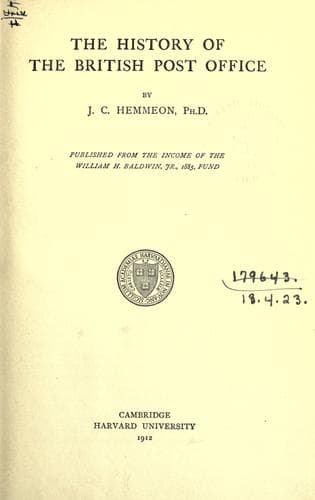
The History of the British Post OfficeHemmeon, Joseph Clarence
History
The History of the British Post Office
Hemmeon, Joseph Clarence
Postal service -- Great Britain -- History
By an act passed in 1827 it was provided that henceforth all rates for
letters conveyed within Ireland should be collected in British currency.
The rates themselves and the distances remained the same as had been
provided by the act of 1814. The postage collected on letters between
the two kingdoms was henceforth to be retained in the country where it
was collected. The rates for letters passing between the two kingdoms
were assimilated with the rates prescribed for Great Britain by the act
of 1812. In addition to the land rates, 2d. was required for the sea
passage to and from Holyhead and Milford and to this 2_d._ more was
added for the use of the Conway and Menai Bridges.[613] Between
Portpatrick and Donaghadee the postage was 4_d._ for a single letter,
between Liverpool and any Irish port 8_d._, but no letter sent via
Liverpool paid a higher rate than if sent via Holyhead.[614] An
additional halfpenny was also demanded on every single letter passing
between Milford Haven and Waterford, to pay for improvements.[615]
[613] 7 and 8 Geo. IV, c. 21. The postage between Liverpool and Dublin
for a single letter was 13_d._, made up as follows:--
Inland postage to Holyhead 9_d._
For the Conway Bridge 1_d._
" " Menai " 1_d._
Sea postage 2_d._
-----
13_d._
In 1820, the sea rate between Portpatrick and Donaghadee had been raised
by 2_d._ for a single letter, between Liverpool and the Port of Douglas
by 4_d._ (1 Geo. IV, c. 89; 3 Geo. IV, c. 105).
[614] 7 and 8 Geo. IV, c. 21; 1 and 2 Geo. IV, c. 35, secs. 19-20; 6
Geo. IV, c. 28.
[615] 6 and 7 Wm. IV, c. 5.
In 1836, England and France signed a postal treaty by which the rates on
letters between the United Kingdom and France or between any other
country and the United Kingdom through France were materially
reduced.[616] On such letters the method of reckoning postage differed
from the English rule and was as follows: One sheet of paper not
exceeding an ounce in weight and every letter not exceeding one quarter
of an ounce were single letters. Every letter with one enclosure only
and not exceeding an ounce in weight was a double letter. Every letter
containing more than one enclosure and not exceeding half an ounce was a
double letter. If it exceeded half an ounce but not an ounce in weight,
it was a triple letter. If it exceeded an ounce, it paid as four single
letters and for every quarter of an ounce above one ounce it paid an
additional single letter rate.[617] The sender of a letter from Great
Britain to France had the option of prepaying the whole postage, British
and foreign, or the British alone, or neither.[618]
[616] _Acc. & P._, 1837, l. 106. Rates on foreign letters before, and
after the French treaty:--
_Between England and_ _Before_ _After_
Public-domain text, read in full here on John Shaqi.
Reviews
Reviews
No reviews yet
Be the first to share your thoughts on this work.
Elsewhere in the archive
Join the Discussion
Join the discussion
Sign in to leave a comment or review.
Sign InorCreate an account