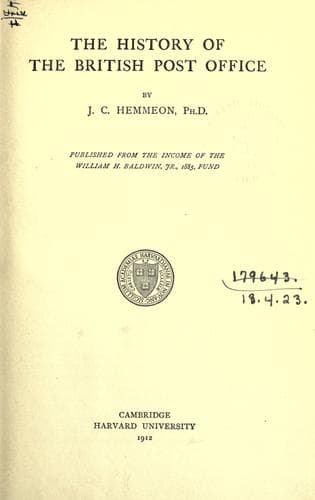
The History of the British Post OfficeHemmeon, Joseph Clarence
History
The History of the British Post Office
Hemmeon, Joseph Clarence
Postal service -- Great Britain -- History
The franking privilege may reasonably be considered in connection with
the history of postal rates, nor should its effect in reducing the
revenue of the Post Office be neglected. The Council of State gave
orders in 1652 that all public packets, letters of members of
Parliament, of the Council, of officers in the public service, and of
any persons acting in a public capacity should be carried free. This is
the first record that we have concerning the free carriage of members'
letters, a privilege which later gave so much trouble and was so much
abused.[627] The next year the Post Office farmers agreed to carry free
all letters to and from members of Parliament provided that letters
written by such members as were not known by their seals should be
endorsed, "These are for the service of the Commonwealth," and signed by
the members themselves or their clerks.[628] Nothing was said in the act
of 1660 about the conveyance of the letters of members of Parliament and
they were carried free only by act of grace. The House of Commons had
passed a clause of the bill providing for the free conveyance of the
letters of members of their own House. This had exasperated the Lords,
who, since they could not amend the clause so as to extend the privilege
to themselves, had dropped it.[629] In 1693, the attention of Cotton and
Frankland was called to the manner in which franking was being abused.
Men claimed the right to frank letters to whom the Postmasters-General
denied it, and members of Parliament were accused of bad faith in the
exercise of their privilege. The custom had arisen of enclosing private
letters in the packet of official letters. A warrant was issued in 1693
to the effect that in future no letters were to go free except those on
the King's affairs, and the only persons to send or receive them free
were the two principal Secretaries of State, the Secretary for Scotland,
the Secretary in Holland, the Earl of Portland, and members of
Parliament, the latter only during the session, and for forty days
before and after, and for inland letters alone. Each member was to write
his name in a book with his seal so that no one might be able to
counterfeit his signature.[630]
[627] _Cal. S. P. D._, 1651-52, p. 507.
[628] _Cal. S. P. D._, 1652-53, p. 449.
[629] _Parliamentary History of England_, iv (1660-88), col. 163.
[630] _Cal. T. P._, 1557-1696, p. 281.
Public-domain text, read in full here on John Shaqi.
Reviews
Reviews
No reviews yet
Be the first to share your thoughts on this work.
Elsewhere in the archive
Join the Discussion
Join the discussion
Sign in to leave a comment or review.
Sign InorCreate an account