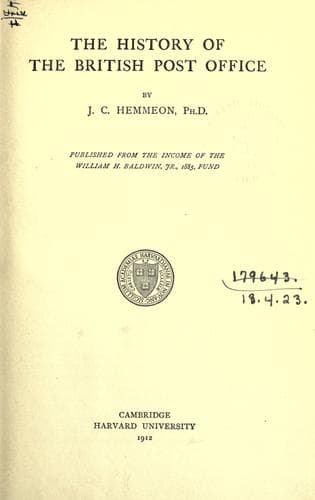
The History of the British Post OfficeHemmeon, Joseph Clarence
History
The History of the British Post Office
Hemmeon, Joseph Clarence
Postal service -- Great Britain -- History
We learn from Hicks' letters that it was customary for clerks in the
Post Office at London to send gazettes to their correspondents in the
country free of charge. These gazettes or news letters were supplied by
the Treasury and, as 2_d._ or 3_d._ apiece was paid for them by the
recipients, the privilege was greatly esteemed.[631] The Deputy
Postmaster-General wished to abolish the privilege, but Hicks himself,
who was one of the favoured officials, was quite indignant at the
suggestion.[632] The principle was bad, but as the receipts for gazettes
formed a necessary part of the clerks' salaries, Hicks cannot be blamed
for protesting against abolition without compensation. James II
expressed a desire that the practice should be discontinued, but when it
was shown to him that the salaries of the clerks must be raised if his
wishes were obeyed, his proposition was promptly withdrawn.[633]
[631] _Cal. T. B. & P._, 1731-34, pp. 208, 210, 218, 268.
[632] _Cal. S. P. D._, 1667, p. 248.
[633] _Cal. S. P. D._, 1666-67, p.386.
The abuses of the privilege of franking were very pronounced during the
eighteenth century. The system of patronage which the members of
Parliament then exercised made them reluctant to offend any of their
constituents, who might entrench upon their peculiar privileges.
Members' names were forged to letters and they made no complaint.
Letters from the country were sent to them to be re-addressed under
their own signatures. The Postmasters-General admonished them more than
once, but, as a rule, the members disclaimed all knowledge of abuses.
Men were so bold as to order letters to be sent under a member's name to
coffee-houses, where they presented themselves and demanded the letters
so addressed. In 1715, on receiving renewed complaints from the
Postmasters-General, it was ordered by the House that henceforth no
member should frank a letter unless the address were written entirely in
his own hand. This was expected to prevent members from franking letters
sent to them by friends. It was also ordered that no letter addressed to
a member should pass free unless such member was actually residing at
the place to which the letter was addressed. In the third place, no
member was to frank a newspaper unless it was entirely in print. This
was to prevent the franking of long written communications passing as
newspapers, for the members of Parliament in sending and receiving
letters free were restricted to such as did not exceed two ounces in
weight, but they were not so restricted in the case of newspapers.[634]
According to the Surveyor's report, the loss from the ministers' franks
in 1717 was £8270 and from the members' franks £17,470.[635] The loss
from franking was proportionately much greater in Ireland than in
England. In 1718 the Irish Parliament sat only three months, in 1719
nine months, and in Ireland as in England, members of Parliament
received and sent their letters free only during the session and forty
Public-domain text, read in full here on John Shaqi.
Reviews
Reviews
No reviews yet
Be the first to share your thoughts on this work.
Elsewhere in the archive
Join the Discussion
Join the discussion
Sign in to leave a comment or review.
Sign InorCreate an account