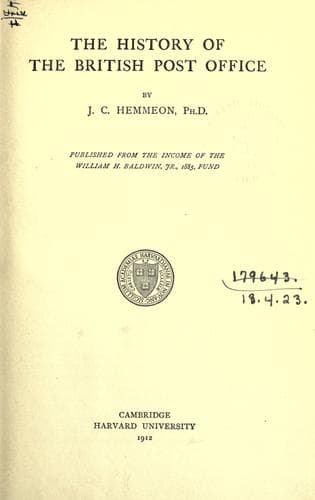
The History of the British Post OfficeHemmeon, Joseph Clarence
History
The History of the British Post Office
Hemmeon, Joseph Clarence
Postal service -- Great Britain -- History
The system of ascertaining forged franks and of discovering enclosures
was as follows: a Supervisor of the Franks charged all letters, franked
by a member's name, coming from any place, when he knew that the member
was not there. Very often by holding them in front of a candle, he could
see enclosures inside directed to other people. If he was in doubt he
generally charged the letter, for if it should pay, all well and good,
and if he had made a mistake, the amount was refunded to the member. The
Supervisor had noticed that the number of franked letters had increased
with every session of Parliament, and some of the ex-members also
attempted to frank letters. The evidence of the Supervisor, especially
his description of the manner in which he attempted to discover
enclosures, was exceedingly distasteful to the House. The members
themselves were to blame for many of the abuses attendant upon the
system, and yet they contended that they were the unwilling victims of
others. A resolution was adopted that it was an infringement upon the
privileges of the knights, citizens, and burgesses chosen to represent
the people of Great Britain in Parliament, for any postmaster, his
deputies or agents to open or look into any letter addressed to or
signed by a member of Parliament, unless empowered so to do by a warrant
issued by one of the Secretaries of State. In addition no postmaster or
his deputies should delay or detain any letter directed to or by any
member unless there should be good reason to suppose that the frank was
a counterfeit.[639]
[639] _Jo. H. C._, 1732-37, p. 476.
The restrictions adopted to curtail the abuse of the franking privilege
had but little effect. A regular business sprang up for selling
counterfeit franks. The House of Lords ordered one person accused of
selling them to come before the bar of the House for examination, but he
failed to present himself.[640] Another confessed before the Upper House
that he had counterfeited one of the Lords' names on certain covers of
letters showed to him and had then sold them. He expressed sorrow for
the offence, which necessity had driven him to commit. He was sent to
Newgate.[641] The abuses of the franking system were so patent[642]
that Allen was told that he might withdraw from his contract to farm the
bye and cross post letters on three months' notice being given.[643]
[640] _Jo. H. L._, 1736-41, p. 259.
[641] _Ibid._, p. 529.
[642] One man in five months counterfeited 14,400 franks of members of
Parliament. Counterfeits of names of 27 members were shown. A regular
trade in buying and selling them had sprung up (_Jo. H. C._, 1761-64, p.
998). Several Lords certified that their names had been counterfeited.
Lord Dacre's name had been counterfeited 504 times (_Jo. H. L._,
1760-64, p. 534).
[643] _Cal. T. B. & P._, 1739-41, p. 450.
Public-domain text, read in full here on John Shaqi.
Reviews
Reviews
No reviews yet
Be the first to share your thoughts on this work.
Elsewhere in the archive
Join the Discussion
Join the discussion
Sign in to leave a comment or review.
Sign InorCreate an account