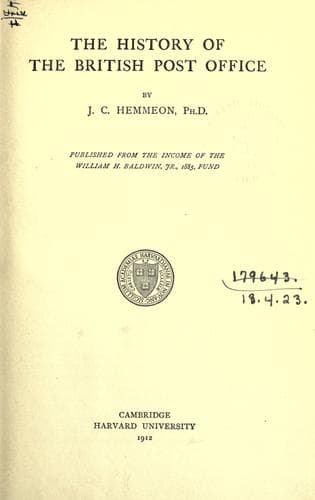
The History of the British Post OfficeHemmeon, Joseph Clarence
History
The History of the British Post Office
Hemmeon, Joseph Clarence
Postal service -- Great Britain -- History
days before and after it. The following is part of the report submitted
by the Postmasters-General to the Lords of the Treasury for these two
years:--
1718 1719
Gross Produce from Letters £14,592 £19,522
Charge of Management and Members' Letters 11,526 18,768
Net Produce from Letters[636] 3,066 754
Under the charges of management is included the charge for carrying
members' letters as reckoned proportionately to the charge for the
letters which paid, together with the actual charge for the pay letters.
The net produce during the three months' session was £3006, during the
nine months' session only £753. In 1734 the old orders about the maximum
weight of two ounces and the requirement for the whole superscription to
be in the member's own writing were repeated in a royal proclamation. In
addition it was ordered that any letters sent under cover to any member
of Parliament or high official of state, to be forwarded by him, should
be sent to the General Post Office to be taxed.[637] It could hardly be
expected that this order would be obeyed, for there was no method of
enforcing it.
[634] _Jo. H. C._, 1714-18, p. 303.
[635] _Cal. T. P._, 1714-19, p. 287.
[636] _Cal. T. P._, 1720-28, p. 77.
[637] _Jo. H. C._, 1732-37, p. 393.
In 1735, the House of Commons instituted an enquiry into the whole
question of franking and summoned various Post Office officials before
them to give evidence. An estimate was laid before them of the amount
lost each year by carrying franked letters. This estimate was obtained
by weighing the franked letters at intervals during the session of
Parliament, and comparing their weight with the weight of the letters
which paid postage. As the total revenue from the latter was known, the
amount which was lost on the former was guessed. The House expressed
very little confidence in the estimated amounts, and certainly it was a
rough way of attaining the object aimed at, but perhaps they were
prejudiced from the strength of the case against them.[638] Expressed in
yearly averages, the amounts by which the revenue was reduced by
franking were:--
1716-19 £17,460
1720-24 23,726
1725-29 32,364
1730-33 36,864
[638] _Ibid._, 1732-37.
Public-domain text, read in full here on John Shaqi.
Reviews
Reviews
No reviews yet
Be the first to share your thoughts on this work.
Elsewhere in the archive
Join the Discussion
Join the discussion
Sign in to leave a comment or review.
Sign InorCreate an account