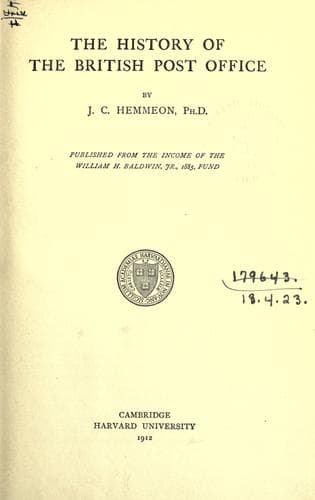
The History of the British Post OfficeHemmeon, Joseph Clarence
History
The History of the British Post Office
Hemmeon, Joseph Clarence
Postal service -- Great Britain -- History
From 1806 to 1819 there was a large extension of the franking privilege
to various officials. During that time sixteen statutes and parts of
statutes were enacted in behalf of various persons from the Lord High
Chancellor to the Controller of the Barrack's Department and the
Commissioners of the parliamentary grant for building churches. Sir
Robert Buxton, a member of Parliament, thought that it would be well for
his fellow members to give up their privilege in order to help the
finances of the country. Windham disagreed on the ground that it kept up
communications between a member and his constituents and encouraged
literary correspondence which would otherwise decline. Pitt justified
it, in that it enabled members to carry on the important business of
their constituents and did not result in much loss to the state.[660]
[660] _Parl. Deb._, 1st ser., iii, col. 570. The following are a few of
the statutes enacted which extended franking: 46 Geo. III, c. 61; 50
Geo. III, c. 65, sec. 19; c. 66; 51 Geo. III, c. 16, sec. 17; 52 Geo.
III, c. 132, sec. 16; c. 146, sec. 11; 53 Geo. III, c. 13; 54 Geo. III,
c. 169; 55 Geo. III, c. 1, sec. 10; c. 60, secs. 41-42; 56 Geo. III, c.
98, sec. 24.
It had always been customary to charge letter rates for the conveyance
of newspapers to foreign countries and to the colonies. Members of
Parliament, however, had the privilege of franking newspapers within the
United Kingdom, the clerks of the Foreign Office franked them to foreign
countries, and the Secretary of the Post Office franked them to the
colonies. In 1825 it was enacted that members need no longer sign their
names to newspapers franked by them, or give notice of the names of the
places to which they intended to send them.[661] This virtually provided
for the free transmission of newspapers within the United Kingdom. At
the same time it was provided that the rate for newspapers, votes and
parliamentary proceedings should be 1-1/2_d._ each to the colonies,
payable in advance. Newspapers from the colonies were charged 3_d._
each, payable on delivery. Such newspapers must be posted on the day of
publication, must contain no writing, and must be enclosed in covers
open at both ends.[662] Two years later the charge for votes and
parliamentary proceedings to and from the colonies was fixed at
1-1/2_d._ an ounce. Newspapers brought from the colonies by private
vessels were to be charged 3_d._ each, the same as the packet rate,[663]
but in 1835 colonial newspapers by private vessels were allowed to come
in for a penny each, and the same rate was charged for English
newspapers sent to the colonies by private vessels. By the same act the
postage on newspapers passing between the United Kingdom and any foreign
country which charged no inland rate for their conveyance was fixed at a
penny each. If an inland rate was charged, the postage was to be 2_d._
for each newspaper plus the foreign rate.[664]
[661] 6 Geo. IV, c. 68, sec. 10.
Public-domain text, read in full here on John Shaqi.
Reviews
Reviews
No reviews yet
Be the first to share your thoughts on this work.
Elsewhere in the archive
Join the Discussion
Join the discussion
Sign in to leave a comment or review.
Sign InorCreate an account