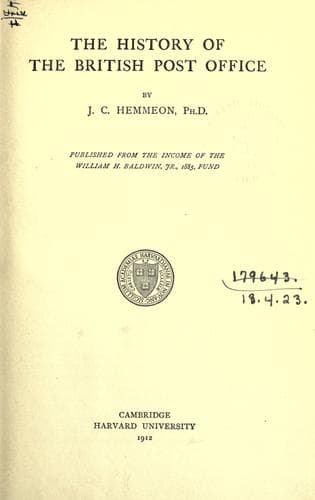
The History of the British Post OfficeHemmeon, Joseph Clarence
History
The History of the British Post Office
Hemmeon, Joseph Clarence
Postal service -- Great Britain -- History
[662] 6 Geo. IV, c. 68; London _Times_, 1825, June 11, p. 3; July 29, p.
2.
[663] 7 and 8 Geo. IV, c. 21.
[664] 5 and 6 Wm. IV, c. 25. Before the passage of this act newspapers
passed free by the packets and posts to and from Hamburg, Bremen, and
Cuxhaven (London _Times_, 1834, Oct. 30, p. 2).
During the following year, all the regulations concerning the conveyance
of newspapers, votes, and proceedings in Parliament etc. were embodied
in one act. Within the United Kingdom all newspapers which had paid the
stamp duty were to go free except those which were sent through the
Twopenny Post and delivered by it, not having passed by the General
Post, and except those posted and delivered within the same town. In
both of these cases one penny was charged. To and from the colonies no
rate was demanded when newspapers were sent by the regular packets. If
sent by private vessels one penny was payable, which went to the master.
The rate to and from foreign countries was fixed at 2_d._ for each
paper, but if a foreign state agreed to charge no postage on English
newspapers, no postage should be charged on the newspapers of such
foreign state, when brought to England by the packet boats. If brought
by private vessels, a penny was payable for each paper, to go to the
master. All newspapers, in order to receive the advantage of these low
rates or to go free, had to be posted within seven days after
publication and to contain no writing except the name and address of the
person to whom they were to be sent. In addition the newspaper must have
no cover or one open at both ends.[665]
[665] 6 and 7 Wm. IV, c. 25.
The following additions and changes in the regulations for the carriage
of newspapers were made in 1837. One penny was to be paid for their
conveyance by private vessels between different parts of the United
Kingdom. Between the colonies and foreign countries through the United
Kingdom, newspapers should go free if conveyed by the packets and should
pay a penny each if conveyed by private vessels. Parliamentary
proceedings conveyed between the colonies and the United Kingdom, if
sent by packet boats and not exceeding one ounce in weight, were charged
1-1/2_d._ each. When in excess of one ounce they paid 1-1/2_d._ for each
additional ounce. Pamphlets, magazines and other periodical publications
for the colonies, if not exceeding six ounces in weight, paid 12_d._
when carried by the packets. For every additional ounce, 3_d._ was
charged. Bankers' re-issuable notes were carried at one quarter the
regular postage.[666] Patterns, with no writing enclosed and not
exceeding one ounce in weight, paid a single letter rate.[667] Any
newspaper which had been posted in violation of any regulation for the
conveyance of newspapers was charged three times the regular letter
postage.[668]
Public-domain text, read in full here on John Shaqi.
Reviews
Reviews
No reviews yet
Be the first to share your thoughts on this work.
Elsewhere in the archive
Join the Discussion
Join the discussion
Sign in to leave a comment or review.
Sign InorCreate an account