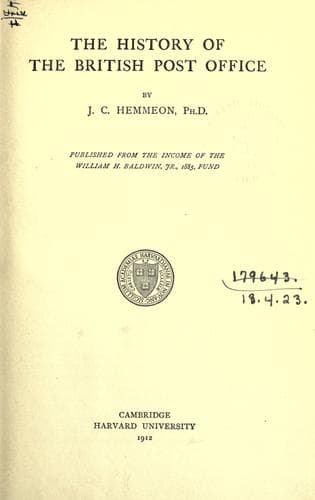
The History of the British Post OfficeHemmeon, Joseph Clarence
History
The History of the British Post Office
Hemmeon, Joseph Clarence
Postal service -- Great Britain -- History
In 1884 the scale of postage applicable to inland letters between two
and twelve ounces in weight was continued without limit. The resulting
rates were as follows: for the first ounce, one penny; for two ounces,
1-1/2_d._; for all greater weights, a halfpenny for every two ounces
plus an initial penny. On the occasion of the sixtieth anniversary of
the late Queen's accession to the throne, further decreases were
announced in the postage on inland letters. The weight carried by the
initial penny was extended from one to four ounces, the postage for
heavier letters increasing as before at the rate of a halfpenny for each
additional two ounces.[686]
[686] _Rep. P. G._, 1885, p. 14; 1898, pp. 1-2.
The decrease in postage for inland matter was accompanied by lower rates
for colonial and foreign letters. Although the proposal of the Marquis
of Clanricarde to establish a definite shilling[687] rate for all
colonial letters was not immediately adopted, it was not long before
even lower rates were accepted. The Marquis' plan was communicated to
the Treasury Lords in 1850 purely on Imperial grounds, "to strengthen
the ties between the colonies and the mother country." Rates other than
those on letters were even then far from excessive. Newspapers, for
instance, often passed free or they were charged a penny each either in
England or the colony, but not in both. Parliamentary proceedings paid
but one penny, sometimes 2_d._ per quarter-pound, books 6_d._ per
half-pound. A few years later a 6_d._ letter rate was adopted for all
parts of the Empire except India, the Cape, Mauritius, and Van Diemen's
Land. In 1857 the 6_d._ rate per half-ounce was extended to all the
colonies and in 1868 to the United States. In the following year this
rate was lowered to 3_d._ for letters to the United States, Canada and
Prince Edward Island.[688] In 1890 this rate in the case of most of the
colonies, and some foreign countries, was still further reduced to
2-1/2_d._, partly no doubt on account of the crusade which Mr. Heaton
had undertaken for penny postage within the Empire.[689] In 1898 his
penny aspirations were realized for all the important colonies with the
exception of the Australasian and South African, and in 1905 these too
fell into line and were joined by Egypt and the Soudan.[690] In 1907,
the experiment was tried of charging the comparatively nominal sum of
one penny a pound on British newspapers, magazines, and trade journals
for Canada, duly registered for the purpose, when sent by direct
Canadian packet. This rate is less than the cost but the loss is
diminished by the fact that the Dominion Government relieves the British
Post Office of the whole cost of ocean transit by the Canadian
subsidized lines.[691]
[687] Even at this time (1850) the shilling rate was the rule.
[688] _Acc. & P._, 1852-53, xcv., 204, pp. 2-3; _Rep. P. G._, 1855, pp.
36-37; 1858, p. 20; _Rep. Com._, 1868-69, vi, p. iv; _Rep. P. G._, 1871,
app., p. 29; 1870, pp. 6-7.
Public-domain text, read in full here on John Shaqi.
Reviews
Reviews
No reviews yet
Be the first to share your thoughts on this work.
Elsewhere in the archive
Join the Discussion
Join the discussion
Sign in to leave a comment or review.
Sign InorCreate an account