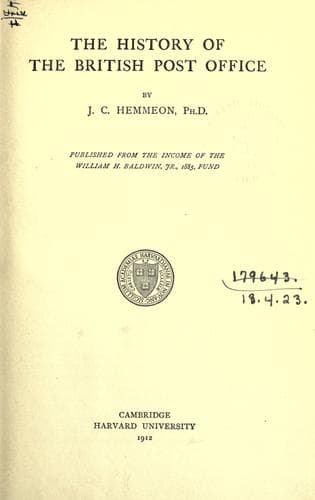
The History of the British Post OfficeHemmeon, Joseph Clarence
History
The History of the British Post Office
Hemmeon, Joseph Clarence
Postal service -- Great Britain -- History
With an increase in the number of valuable articles carried by post and
better arrangements for their safe keeping, it was found possible to
reduce the registration fee from 11_d._ to 6_d._, then to 4_d._ and
eventually to 2_d._ At the time of the first reduction, a rule was
issued for the compulsory registration by the Post Office of all letters
unquestionably containing coin, for the sake of letter carriers and
others rather than the protection of the public. The Post Office did not
at the time of the first reduction hold itself responsible for the full
value of the contents of a lost registered letter but was accustomed to
remunerate the sender where the contents were proved, were of moderate
amount, and the fault clearly lay with the Post Office. In 1878 it
agreed to make good up to £2 the value of the contents of any registered
letter which it lost, stipulating in the case of money that it had been
sent securely and in one of its own envelopes. Compulsory registration
by the Post Office was also extended to include uncrossed cheques and
postal orders to which the name of the payee had not been appended.[682]
[682] _Rep._ P. G., 1862, pp. 9-10; 1879, p. 13; 1897, p. 5.
An inland parcel post was not established in England until 1883. An
initial rate of 3_d._ was imposed for the first pound, increasing by
increments of 3_d._ to 1_s._ for the seventh pound. Later the maximum
weight was increased to 11 pounds, the maximum charge to 1_s._ 6_d._ In
1905 a further reduction followed on parcels weighing more than four
pounds.[683]
[683] _Ibid._, 1896, p. 3; 1882, p. 3; 1906, p. 1.
The use of postcards was first permitted in England in 1870, a charge of
a halfpenny a dozen being made in addition to the stamp. In 1875 this
additional charge was increased to a penny a dozen for thin cards, 2_d._
for stout cards. In 1899 these prices were reduced to a penny for ten
stout cards, a halfpenny for ten thin ones, and the latter began rapidly
to displace the former. Private post cards were first allowed to pass
through the post in 1894 for a halfpenny each, and two years later the
charge on unpaid inland post cards was reduced from 2_d._ to a
penny.[684] At the same time that the use of post cards was allowed, a
half penny post was introduced for certain classes of formal printed
documents.[685]
[684] _Ibid._, 1896, p. 2; 1889, p. 2; 1897, p. 5; 1895, p. 18.
[685] _Ibid._, 1903, p. 5.
Public-domain text, read in full here on John Shaqi.
Reviews
Reviews
No reviews yet
Be the first to share your thoughts on this work.
Elsewhere in the archive
Join the Discussion
Join the discussion
Sign in to leave a comment or review.
Sign InorCreate an account