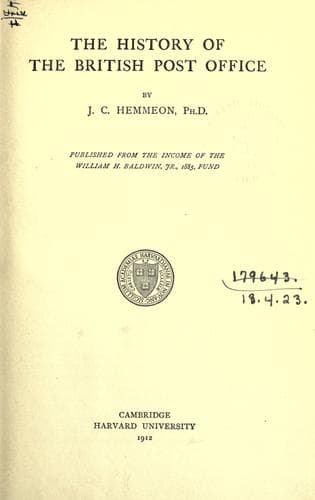
The History of the British Post OfficeHemmeon, Joseph Clarence
History
The History of the British Post Office
Hemmeon, Joseph Clarence
Postal service -- Great Britain -- History
Our ideas of the financial operations of the Post Office from 1635 to
1711 are somewhat clearer than during the preceding period. We know that
Witherings' aim was to make the system self-supporting. It had probably
not entered into his head that it might ever be anything more. After the
sequestration of the position of Postmaster-General to Burlamachi, he
was called upon to render an account of the financial proceedings of the
Post Office during the short period that he was in charge.[706] He
reported that from August 4, 1640, to December 25, 1641, the receipts
had been £8363 and the expenditure £4867. £1400 of the balance had been
paid to the Secretary of State and "of the remaining £2000, those that
keep the office are to be considered for their pains and attendance."
This is rather vague but the report shows that the Post Office was
self-supporting only six years after Witherings' reforms had been
adopted.[707] Prideaux reported at an early period in his régime that,
with the exception of the Dover road and the Holyhead packet, the posts
paid for themselves.[708] After the Post Office was farmed, there can be
no doubt as to the total net revenue, but it is impossible to say how
much the farmer made over and above the amount of his farm or how large
his expenses were. Manley paid the state £10,000 a year and is said to
have made £14,000 during the six years that he farmed the Posts.[709] In
1659 the rent was raised to £14,000[710] a year, and in 1660 there was a
further advance to £21,500.[711] Of this £21,500 the Duke of York
received £16,117 and the rest was spent largely in paying pensions and
for a few minor expenses such as the payment of the Court
Postmaster.[712] By the act of 1663, the net Post Office revenue was
settled upon the Duke of York and his male heirs, with the exception of
about £5000 a year, that being the amount of the pension charges on the
revenue.[713] Certain deductions were made from the sum total of rent
due, on account of the loss to the farmer from the activity of the
interlopers, and the deficit was ordered to be made up from some other
branch of the royal revenue.[714]
[706] _Cal. T. P._, 1697-1702, p. 289.
[707] _Cal. S. P. D._, 1641-43, p. 213.
[708] _Jo. H. C._, 1648-51, p. 385.
[709] _Cal. S. P. D._, 1653-54, p. 365.
[710] Hist. MSS. Com., _Rep._, 15, app., pt. 1, p. 97.
[711] _Rep. Com._, 1844, xiv, app., p. 76 (53).
[712] _Cal. S. P. D._, 1661-62, pp. 122, 245.
[713] 15 Chas. II, c. 14.
[714] _Cal. S. P. D._, 1663-64, p. 598.
Public-domain text, read in full here on John Shaqi.
Reviews
Reviews
No reviews yet
Be the first to share your thoughts on this work.
Elsewhere in the archive
Join the Discussion
Join the discussion
Sign in to leave a comment or review.
Sign InorCreate an account