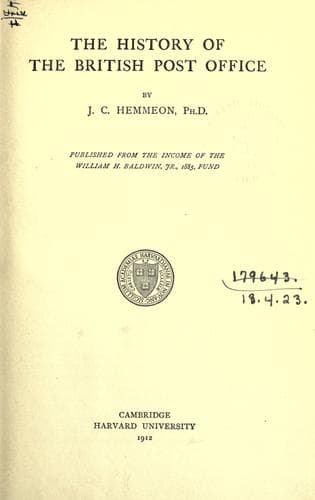
The History of the British Post OfficeHemmeon, Joseph Clarence
History
The History of the British Post Office
Hemmeon, Joseph Clarence
Postal service -- Great Britain -- History
Rowland Hill has pointed out that from 1815 to 1835 the population had
increased from 19,552,000 to 25,605,000 while the net revenue from the
Post Office had remained practically stationary. He said nothing,
however, about the industrial depression of the country during that
period nor of the political and economic crisis through which England
was passing. He referred to the great increase in the postal revenue of
the United States during the same period; on the one hand, a nation with
immense natural resources and a population doubling itself every
generation, and on the other hand, a people inhabiting two small
islands, making heroic efforts to recover from a most burdensome war.
With the introduction of penny postage the gross revenue of the Post
Office fell from £2,390,763 in 1840 to £1,359,466 in 1841, and did not
fully recover from the decreased postage rates for twelve years. The
cost of management, on the other hand, increased only from £756,999 in
1840 to £858,677 in 1841. But the financial loss is shown most plainly
in the falling off in net revenue from £1,633,764 to £500,789. If we
exclude packet expenses, and such was the practice until 1858, the net
revenue did not again reach the maximum figure of high postage days
until 1862. Including packet expenses we find that the net revenue did
not fully recover until the early seventies. The average yearly gross
revenue for the period from 1841-45 was £1,658,214, expenditure
£1,001,405, and the net revenue £656,809. These all increased steadily
and on the whole proportionately until 1860, the average yearly figures
for the preceding five years being £3,135,587, £1,785,911, and
£1,349,676. In 1858 the packet expenses are included under cost of
management and their enormous increase from the beginning of the century
sadly depleted the net revenue. It seems more advisable, however, not to
include them until 1860 when the packets passed from the control of the
Admiralty to that of the Post Office. The average gross revenue for the
years 1861 to 1865 was £4,016,750, expenditure (including packets)
£3,013,389, and net revenue £1,003,341. During the next quarter of a
century these increased to £6,326,141, £4,019,423, and £2,306,718
respectively, exclusive of telegraph receipts and expenditures. For the
five years ending 31st March, 1906, the average gross revenue was
£15,926,905, expenditure £11,156,292, and net revenue £4,770,613.[730]
[730] See Appendix, pp. 249, 250, 251, Table VI; p. 252, Table VII.
CHAPTER IX
THE QUESTION OF MONOPOLY
Public-domain text, read in full here on John Shaqi.
Reviews
Reviews
No reviews yet
Be the first to share your thoughts on this work.
Elsewhere in the archive
Join the Discussion
Join the discussion
Sign in to leave a comment or review.
Sign InorCreate an account