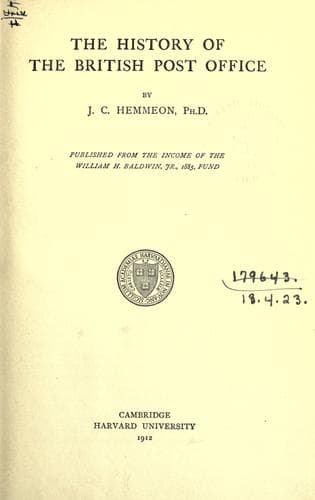
The History of the British Post OfficeHemmeon, Joseph Clarence
History
The History of the British Post Office
Hemmeon, Joseph Clarence
Postal service -- Great Britain -- History
In 1591 the first proclamation affirming the government monopoly in the
foreign posts was issued. All persons except the Postmaster-General and
his deputies were forbidden "directly or indirectly to gather up,
receive, bring in or carry out of this realm any letters or packets,"
the only exceptions being in the case of the despatches of the
principal Secretaries of State, of Ambassadors, and others sufficiently
authorized. An appendix to the same proclamation commanded all mayors,
bailiffs, sheriffs, justices, etc., and especially all searchers to be
on the watch for men coming into or going out of the realm with packets
or letters. In this last part of the proclamation we can see why it was
thought necessary to restrict the carriage of letters to and from
foreign countries to the Royal Posts. It was done that the Government
might be able to discover any treasonable or seditious correspondence.
This did not always remain the object of the state in restricting
competition but was succeeded later by other and different motives. In
order that there might be no doubt about the whole question, the
Postmaster-General received word from the Council to inform the London
merchants, foreigners as well as British subjects and all others whom it
might concern, that they should no longer employ any others to carry
their letters than those legally appointed in accordance with the terms
of the proclamation.[734]
[734] _Rep. Com._, 1844, xiv, 601, p. 4; app., p. 36 (14).
In 1602 the first order concerning the despatch of private letters
within the kingdom was issued to the Royal Posts. "The Posts for the
Queen's immediate service"[735] were allowed to carry only state
despatches, directed by members of the council, the Postmaster-General
and certain officials. Such despatches when sent by the regular posts
were to be forwarded immediately. The letters of all other persons
allowed to write by post must wait for the regular departure of the
postmen. In the orders to the posts issued in 1609, the first article
reads as follows: "No pacquets or letters shall be sent by the Posts or
bind any Post to ride therewith but those on Our special affairs."[736]
The first part of this is certainly strong but it is modified by the
succeeding clause "nor bind any Post to ride therewith." Evidently he
might if he wished, and he would probably hesitate longer over a state
packet for the conveyance of which he was never assured of anything than
over a private letter for which he was certain of his pay.
[735] By "Posts for the Queen's immediate service" was probably meant
the special messengers attached to the Court.
[736] _Cal. S. P. D._, 1547-65, pp. 215-77; _Rep. Com._, 1844, xiv, 601,
app., p. 42 (20).
Public-domain text, read in full here on John Shaqi.
Reviews
Reviews
No reviews yet
Be the first to share your thoughts on this work.
Elsewhere in the archive
Join the Discussion
Join the discussion
Sign in to leave a comment or review.
Sign InorCreate an account