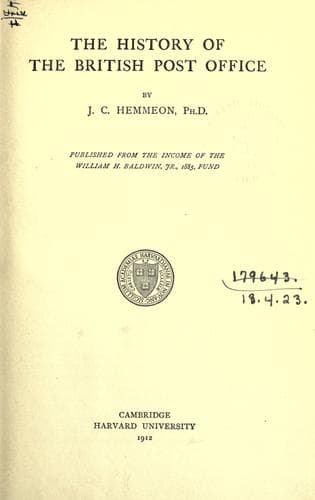
The History of the British Post OfficeHemmeon, Joseph Clarence
History
The History of the British Post Office
Hemmeon, Joseph Clarence
Postal service -- Great Britain -- History
It was the custom after 1609 to follow the appointment of every new
Postmaster-General with a proclamation assigning him and his deputies
the sole privilege of carrying all letters and reading anathema upon all
interlopers.[737] Thus King James favoured Stanhope, his
Postmaster-General, with a grant of monopoly.[738] On de Quester's
appointment as Foreign Postmaster-General a proclamation was issued,
forbidding any but his agents from having anything to do with foreign
letters.[739] In spite of the improvements which he inaugurated, we find
him asking the King a few years later to renew his patent of monopoly
and his request was granted.[740] He was evidently suffering from
competition. But the Merchant Adventurers' Posts were not yet dead and
their Postmaster, Billingsley, abetted by the House of Commons,[741]
gave de Quester so much trouble that he was imprisoned by the Council's
order.[742]
[737] Letters carried by a friend or special messenger or a common
carrier were excepted.
[738] _Rep. Com._, 1844, xiv, 601, app., p. 42 (20).
[739] _Ibid._, 1591-94, p. 401.
[740] _Ibid._, 1627-28, pp. 511-22.
[741] The House had already shown its interest in postal affairs by
summoning postmasters before the Committee of Grievances in 1624 (_Jo.
H. C._, 1547-1628, pp. 689-774).
[742] _Cal. S. P. D._, 1628-29, p. 177.
In the meantime the postmen on the London-Plymouth road had petitioned
the Council that they alone should carry the letters and despatches of
the merchants over their road. They said they had so improved the
service between London and Plymouth that letters were now despatched
between the two cities in three days and an answer might be received
within one week from the time of first writing. Their complaint was
against a certain Samuel Jude, who had undertaken the conveyance of the
London merchants' letters. Jude himself acknowledged this, but said that
he had never meddled with the "through" post by which he meant the
travellers' post.[743]
[743] _Ibid._, 1625-49, p. 367; 1629-31, p. 200.
Public-domain text, read in full here on John Shaqi.
Reviews
Reviews
No reviews yet
Be the first to share your thoughts on this work.
Elsewhere in the archive
Join the Discussion
Join the discussion
Sign in to leave a comment or review.
Sign InorCreate an account