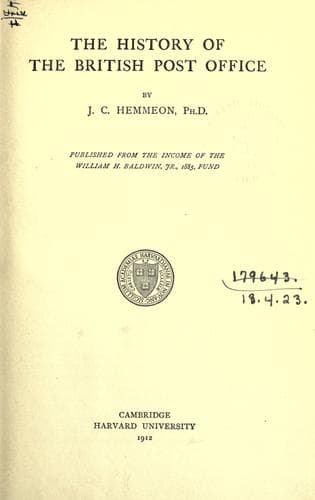
The History of the British Post OfficeHemmeon, Joseph Clarence
History
The History of the British Post Office
Hemmeon, Joseph Clarence
Postal service -- Great Britain -- History
In 1663 a certain Thomas Ibson attempted to come to an agreement with
the postmasters on the Holyhead road. He wished to have the privilege
of horsing travellers and made an offer to the postmasters to take
charge of the post houses if they would allow him to proceed. He told
them that they should make an attempt to have their salaries restored to
their old value by Bishop, who had raised so much from them by fines and
lowering their salaries. The Postmaster-General told his deputies that
if they dared to treat with the "would-be" interloper he would dismiss
them, and the whole thing fell through.[763] At the same time a warrant
was issued by the Council to mayors and other officials to search for
and apprehend all persons carrying letters for hire, without licence
from the Postmaster-General.[764] Nevertheless interloping did not
cease, as is shown by the complaints from the postmasters.[765]
[763] _Cal. S. P. D._, 1663-64, pp. 8, 18.
[764] _Ibid._, 1663-64, p. 145.
[765] _Ibid._, 1663-64, p. 402.
In the proclamation following the appointment of O'Neale as
Postmaster-General in 1663, it was ordered that no one should dare to
detain or open a letter not addressed to himself unless under a warrant
from one of the Secretaries of State. An exception was made in the case
of letters carried by unauthorized persons. Such letters should be
seized and sent to the Privy Council. In later proclamations it was
provided that they might be sent also to one of the Secretaries of State
in order that the persons sending or conveying them might be
punished.[766]
[766] _Rep. Com._, 1844, xiv, 601, app., p. 88 (61).
After Lord Arlington's appointment as Postmaster-General, he addressed a
petition to the Duke of York complaining "that carriers, proprietors of
stage coaches and others take upon themselves to collect letters to an
incredible number and on some stages double what the post brings." On
account of this he pointed out to His Royal Highness that a considerable
part of his revenue was lost. This was quite true since the Post Office
had ceased to be farmed and the whole net revenue went to the Duke.[767]
This was followed the same year by a proclamation forbidding any one to
collect or carry letters without the authority of the
Postmasters-General. Carriers were forbidden to convey any letters which
were not on matters relating to goods in their carts. Shipmasters must
carry no letters beyond the first stage after their arrival in England
with the exception of the letters of merchants and owners. Searchers
were appointed to see that the proclamation was enforced.[768] It was
even proposed to suppress all hackney coaches, the principal reason
given being that they decreased the value of the Duke's monopoly by
carrying multitudes of letters.[769]
[767] _Cal. S. P. D._, 1668-69, p. 285.
[768] _Cal. S. P. D._, 1668-69, p. 376.
[769] _Ibid._, 1672-73, p. 64.
Public-domain text, read in full here on John Shaqi.
Reviews
Reviews
No reviews yet
Be the first to share your thoughts on this work.
Elsewhere in the archive
Join the Discussion
Join the discussion
Sign in to leave a comment or review.
Sign InorCreate an account