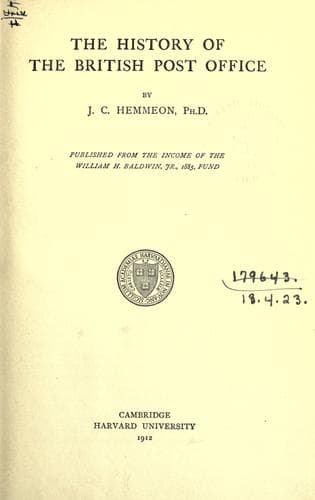
The History of the British Post OfficeHemmeon, Joseph Clarence
History
The History of the British Post Office
Hemmeon, Joseph Clarence
Postal service -- Great Britain -- History
It is a curious and interesting fact that for a short time London had a
Half Penny Post, established in 1708 by a Mr. Povey in opposition to the
regular Penny Post. The idea was much the same as that of Dockwra's
although Povey seems to have been a far more belligerent individual than
his forerunner in the work. The Postmasters-General tried to come to
some compromise with him but he would not listen to them. Finally legal
action was brought against him, based on the monopoly granted by the act
of 1660. Povey lost the suit and his project fell through.[770] His was
the last attempt to organize a regular system of competing posts. During
the remainder of the eighteenth century, improvements in postal
communications disarmed much of the former opposition. Considerable
damage was received from the superior speed with which letters might be
sent by coaches but, after they were adopted by the Post Office, matters
naturally adjusted themselves. Private vessels continued to convey
letters which had not paid the rates prescribed in such cases by the act
of 1711, but this breach of the law was tolerated by the Post
Office.[771]
[770] Knight, _London_, 1842, iii, p. 282; Joyce, pp. 121-23.
[771] Joyce, p. 329.
Before the nineteenth century, opposition to the government monopoly had
taken the form of competing systems of communication, started primarily
for the sake of making money and at the same time vindicating the
principle of competition. During the first forty years of the nineteenth
century there was no opposition to the Post Office as a monopoly. The
widespread dissatisfaction was due to the exorbitant rates of postage
and this dissatisfaction expressed itself in attempts to evade these
rates but, with the exception of individual messengers and carriers,
there was no competing system of postal communication established.
Opposition took the form of evasion of postage payments by legal and
illegal means. The various exceptions to the government monopoly
continued unchanged[772] until still further modified in 1837. The
additional modifications were in the case of commissions and returns,
affidavits, writs and legal proceedings, and letters sent out of the
United Kingdom by private vessels.[773] The penalty for infringing upon
the postal monopoly was placed at £5 for every offence or £100 a week if
the offence was continued.[774]
[772] 9 Anne, c. 10; 42 Geo. III, c. 81; 46 Geo. III, c. 92; 53 Geo.
III, c. 58; 5 Geo. IV, c. 20.
[773] 7 Wm. IV and 1 Vict., c. 33.
[774] 7 Wm. IV and 1 Vict., c. 36.
Public-domain text, read in full here on John Shaqi.
Reviews
Reviews
No reviews yet
Be the first to share your thoughts on this work.
Elsewhere in the archive
Join the Discussion
Join the discussion
Sign in to leave a comment or review.
Sign InorCreate an account