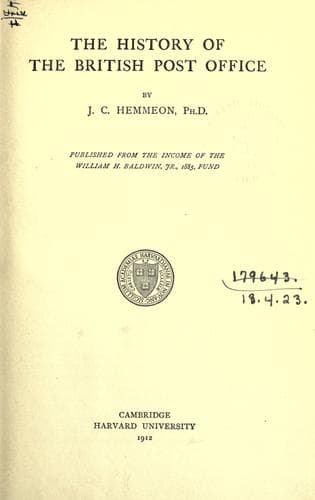
The History of the British Post OfficeHemmeon, Joseph Clarence
History
The History of the British Post Office
Hemmeon, Joseph Clarence
Postal service -- Great Britain -- History
During the official postal year from July 1831 to July 1832, there were
133 successful prosecutions for illegally sending and conveying letters.
The fines collected amounted to £1635, the costs paid by defendants to
£1085. The prosecutions were generally for a few letters only and the
great majority of the cases were brought in Manchester. In the case of
forty-one additional actions, the Postmaster-General did not enforce the
penalties, certain explanations having been given.[775] Rowland Hill
thought that the conveyance of letters by private and unauthorized
people was very widespread and the Solicitor of the Post Office agreed
with him.[776]
[775] _Acc. & P._, 1834, xlix, 19, pp. 2-7.
[776] _Rep. Com._, 1837-38, xx, pt. 1, pp. 17, 23.
The reports of the Committee appointed to enquire into the condition of
the Post Office and to hear the opinions of officials and the public
concerning the introduction of Penny Postage disclosed an amazing state
of affairs. The opinion that evasion of postage was more or less general
had been held by the public for some time as well as by a few of the
Post Office officials[777] but, after the evidence upon the question was
published, there was no longer any doubt that the views of the public
were correct. Some difficulty had been anticipated that men who had
violated the law of the land would prefer not to confess their misdeeds
before a Parliamentary Committee. They were accordingly assured that any
evidence given would not be used against them, and the names of some
were expressed by letters only, when the reports were published.
[777] _Ibid._, 1837-38, xx, questions 234, 2883, 4692, 10870-74; rep. 1,
app., pp. 427, 431, 433; rep. 2, p. 32.
The means by which postage rates were evaded may be conveniently grouped
under two main heads, legal and illegal. The most common methods of
evading postage in whole or in part by legal means were:--
By the use of Parliamentary and Official franks.[778]
By enclosing invoices and other communications in goods.[779]
By the use of codes and signals expressed by sending
particular newspapers or, when something in the nature
of news or reports was to be communicated to many, an
advertisement or report was printed in a newspaper and
the newspapers were sent.[780]
By means of a letter or package sent to a mercantile house
with many letters on one sheet of paper for other people.
These were delivered by messengers. Money was sometimes
sent in the same way.[781]
[778] _Rep. Com._, 1837-38, xx, qs. 3452, 3754-56, 4330-33, 4152, 6059,
6204, 6971, 8051, 9122-30, 10481, 5486-92-95, 4934-45, 5536, 3953,
6174-87. By this means Dr. Dionysius Lardner sent and received the
greater part of an extensive literary correspondence (qs. 5487-96).
[779] _Ibid._, 1837-38, xx, qs. 3206-07, 3368-69, 3516-45, 3872, 4080,
4116-17, 4906, 5434, 6895, 7740, 7742-50, 7242-48.
[780] _Ibid._, 1837-38, xx, qs. 3923, 6683, 7419-23.
Public-domain text, read in full here on John Shaqi.
Reviews
Reviews
No reviews yet
Be the first to share your thoughts on this work.
Elsewhere in the archive
Join the Discussion
Join the discussion
Sign in to leave a comment or review.
Sign InorCreate an account