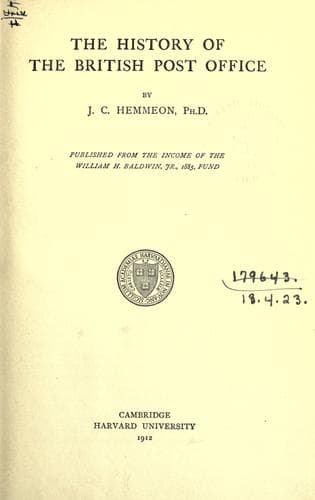
The History of the British Post OfficeHemmeon, Joseph Clarence
History
The History of the British Post Office
Hemmeon, Joseph Clarence
Postal service -- Great Britain -- History
Since the Post Office has adopted the policy of charging low uniform
rates of postage there has been no concerted attempt to infringe upon
its monopoly. The dissatisfied do not now attempt to establish competing
posts nor to evade the payment of the legal rates. Any pressure which
may be brought to remedy real or supposed grievances takes the form of
an attempt to influence the department itself. It is true that a private
messenger service was established for the delivery of letters, but the
promoters of that service seem to have been unaware of the fact that
they were acting in violation of the law, and a satisfactory agreement
with the department was soon concluded. As a matter of fact, it is a
question whether succeeding governments have not been too subservient
in granting the demands of certain sections of the people, notably in
connection with the telegraph and telephone systems and the question of
guarantees. The position of a government which has abandoned the
principle that any extension of services or change in postal policy
shall be based upon present or anticipated financial success must
necessarily be a difficult one.
CHAPTER X
THE TELEGRAPH SYSTEM AS A BRANCH OF THE POSTAL DEPARTMENT
Previous to the acquisition of the telegraphs by the state, the
different telegraphic companies carried on their business in comparative
harmony, a harmony which was occasionally disturbed by the entrance into
the field of competition of new claimants for the confidence of the
public. By far the most important of these companies in 1855 were the
Electric and International, and the British and Irish Magnetic,
controlling between them about 8500 miles of line and having 600
stations open to the public. During the succeeding ten years, by the
growth of the old companies and an increase in the number of the new,
the number of miles of line increased to 16,000, of telegraph stations
to 2040. The number of public messages sent in 1855 was a little more
than one million, in 1860 nearly two millions, and in 1865 over four
millions and a half. The rates for a message of twenty words varied from
1_s._ for a distance under fifty miles, plus 1_s._ for each additional
fifty miles, to 4_s._ for a distance over 150 miles and 5_s._ to Dublin,
including free delivery within half a mile from the telegraph
office.[797]
Public-domain text, read in full here on John Shaqi.
Reviews
Reviews
No reviews yet
Be the first to share your thoughts on this work.
Elsewhere in the archive
Join the Discussion
Join the discussion
Sign in to leave a comment or review.
Sign InorCreate an account