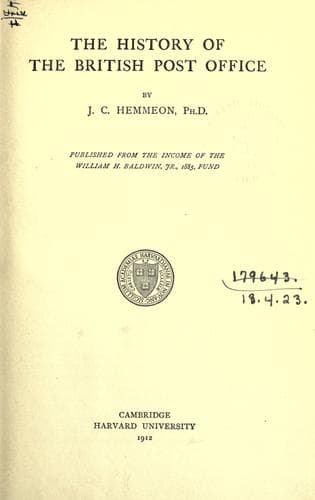
The History of the British Post OfficeHemmeon, Joseph Clarence
History
The History of the British Post Office
Hemmeon, Joseph Clarence
Postal service -- Great Britain -- History
In 1860 a competing company, the London District Telegraph Company,
started operations in the Metropolitan District, and offered a low rate
of 6_d._ a message. In the following year a far more dangerous rival,
the United Kingdom Telegraph Company, announced that henceforth it would
charge a uniform shilling rate irrespective of distance. Four years
later both of these companies fell into line, forced according to some
by the unfair tactics of their competitors, according to others by the
utter impossibility of making both ends meet, while charging a uniform
rate irrespective of distance. The tariff agreed to in 1865 was as
follows:--[797] _Acc. & P._, 1867-68, xli, 202, pp. 43, 73, 74.
For a distance not exceeding 100 miles 1_s._
from 100 to 200 miles 1_s._ 6_d._
beyond 200 miles 2_s._
Between Great Britain and Ireland from 3_s._ to 6_s._
In some cases these rates applied only to wires of a single company,
and, where a message was transmitted over the wires of two or more
companies, an additional charge was made. Special rates were offered for
press messages, the news being supplied by the agency of the
intelligence department of the telegraph companies.[798]
[798] _Acc. & P._, 1867-68, xli, 202, pp. 87-88, 126; _Rep. Com._,
1867-68, xi, 435, pp. 31, 68.
The earliest proposal for government ownership of the telegraphs seems
to have originated with Thomas Allan, the same Allan who was later
instrumental in establishing the United Kingdom Telegraph Company. In
1854 he submitted arguments to the government through Sir Rowland Hill
in favour of the change, arguments which met with the approval of Lord
Stanley, the President of the Board of Trade, and Mr. Ricardo, formerly
Chairman of the International Electric Telegraph Company, and ex-member
for Stoke. Two years later Mr. Barnes, an official in the Post Office
Department, submitted to my Lords a plan "for the establishment in
connection with the Post Office of a comprehensive scheme of electric
telegraphs throughout the kingdom." In 1866, Lord Stanley, as
Postmaster-General, in a letter to the Lords of the Treasury called
their attention to the fact that the question of the propriety of the
assumption by the government of the telegraphic systems of the Kingdom
had been revived in the previous year by the Edinburgh Chamber of
Commerce, and still more recently the proposition had been embodied in a
petition from the Association of Chambers of Commerce of the United
Kingdom. As he himself had for many years been in favour of such a
change and found his opinion shared by more than one important body of
public men, he directed Mr. Scudamore[799] to report whether, in his
opinion, the telegraphs could be successfully operated by the Post
Office, whether such operation would result in any advantages to the
public over the present system by means of private companies, and
whether it would entail upon the department any large expenditure beyond
Public-domain text, read in full here on John Shaqi.
Reviews
Reviews
No reviews yet
Be the first to share your thoughts on this work.
Elsewhere in the archive
Join the Discussion
Join the discussion
Sign in to leave a comment or review.
Sign InorCreate an account