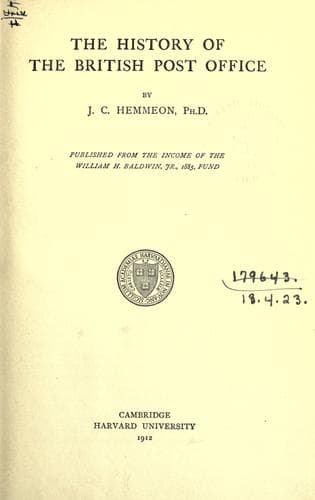
The History of the British Post OfficeHemmeon, Joseph Clarence
History
The History of the British Post Office
Hemmeon, Joseph Clarence
Postal service -- Great Britain -- History
In 1868, the Postmaster-General was given authority by act of Parliament
to purchase the undertakings of the telegraph companies and also the
interests of the railways in the conveyance of public messages, together
with a perpetual way-leave for telegraphic purposes over the properties
of the railway companies. Any telegraph company, with the authority of
two thirds of the votes of its shareholders, was empowered to sell to
the Postmaster-General all or any portion of its undertaking. When the
Postmaster-General had acquired the property of any telegraph company,
he must also, upon the request of any other company, purchase its
undertaking, this privilege being extended also to the railways so far
as telegraphs operated by them for transmitting public messages were
concerned. The price paid for the Electric and International, the
British and Irish Magnetic, and the United Kingdom Telegraph Companies
was fixed at twenty years' purchase of their net profits for the year
ending 30th June, 1868. In the case of the United Kingdom Telegraph
Company additional sums were to be paid for the Hughes type-printing
patent, for the estimated aggregate value of its ordinary share capital
as determined by its highest quotation on any day between the 1st and
25th days of June, 1868, for compensation for the loss of prospective
profits on its ordinary shares, and any sum that might be determined as
loss for its attempt to establish a uniform shilling rate. Every officer
or clerk of the companies who had been in receipt of a salary for not
less than five years or of remuneration amounting to not less than £50 a
year for not less than seven years, if he received no offer from the
Postmaster-General of an appointment in the telegraphic department of
the Post Office equal in the opinion of an arbitrator to his former
position, was entitled to receive an annuity equal to two thirds of his
annual emolument if he had been in service twenty years, such annuity to
be diminished by one twentieth for every year less than twenty. Those
entering the service of the Postmaster-General were entitled to count
their past continuous years of service with the companies as years in
the service of the Crown.
Public-domain text, read in full here on John Shaqi.
Reviews
Reviews
No reviews yet
Be the first to share your thoughts on this work.
Elsewhere in the archive
Join the Discussion
Join the discussion
Sign in to leave a comment or review.
Sign InorCreate an account