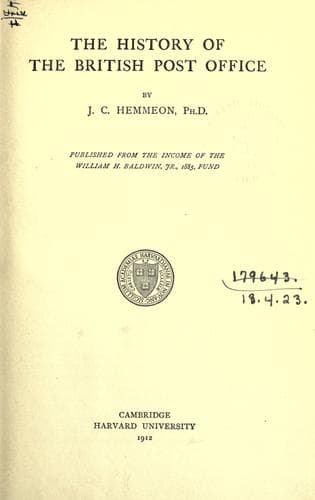
The History of the British Post OfficeHemmeon, Joseph Clarence
History
The History of the British Post Office
Hemmeon, Joseph Clarence
Postal service -- Great Britain -- History
For the most part all the telegraph apparatus belonging to the railway
companies and all belonging to the telegraph companies on the railway
lines necessary for the private business of the railways were handed
over to the railways by the Postmaster-General free of charge. He was
given the use, from telegraph stations not on the railway lines, of all
the wires of the telegraph companies on the lines employed exclusively
in the public telegraph business. The railways might affix wires to the
posts of the Postmaster-General on the line, and in like manner he might
require the railways to affix wires to their own posts for the use of
the Post Office or erect new posts and wires. Finally the railways were
required to act as agents of the Postmaster-General, if required, for
receiving and transmitting messages. The railways as a rule succeeded in
driving a very sharp bargain with the Government for the purchase of
their interests in the public telegraph business. The price paid was
twenty years' purchase of the net receipts from public telegrams
reckoned for the year ending 30th June, 1868, plus twenty times the
increase in net receipts for the three preceding years or for such
shorter period as the business of transmitting public telegrams had been
undertaken. In addition, compensation was made for the rents, etc.,
payable to the railways by the telegraph companies, for the unexpired
period of their respective agreements, for the right of way obtained by
the Postmaster-General over the lands of the railways, for the loss of
power on the part of the railways to grant way-leaves, for the value of
the railways' reversionary interests (if any) in the transmission of
public messages on the expiration of the agreements with the telegraph
companies, and for any loss the railways might suffer in working their
telegraph business as a separate concern. Finally the Postmaster-General
was required to convey free of charge to any part of the United Kingdom
all messages of the railways relating to their own private
business.[805] The act empowering the Postmaster-General to purchase the
undertakings of the telegraph companies did not confer upon the Post
Office a monopoly in the transmission of telegrams, Mr. Scudamore
himself declaring that such a monopoly was neither desirable nor did the
Post Office wish it. The second act, however, declared that no
telegraphic messages, except those sent from or to any place outside of
the United Kingdom, should be transmitted by any telegraphic company for
gain unless the company was in existence on the 22d of June, 1869, and
was not for the time being acquired by the Postmaster-General, who
should be required to purchase its undertaking upon demand.[806]
[805] 31 and 32 Vict., c. 110.
[806] 32 and 33 Vict., c. 75.
Public-domain text, read in full here on John Shaqi.
Reviews
Reviews
No reviews yet
Be the first to share your thoughts on this work.
Elsewhere in the archive
Join the Discussion
Join the discussion
Sign in to leave a comment or review.
Sign InorCreate an account