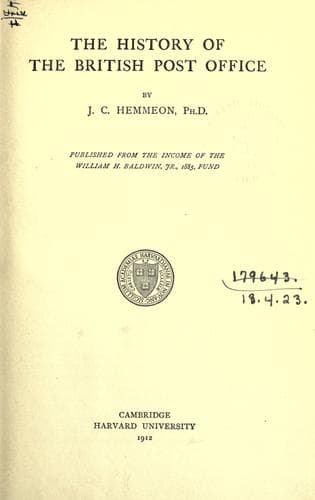
The History of the British Post OfficeHemmeon, Joseph Clarence
History
The History of the British Post Office
Hemmeon, Joseph Clarence
Postal service -- Great Britain -- History
When the Post Office acquired the telegraphs, a uniform rate was
introduced of 1_s._ for twenty words or part thereof and 3_d._ for each
additional five words or part thereof, exclusive of the names and
addresses of sender and receiver, which were transmitted free. Delivery
was free within a radius of one mile from the terminal telegraphic
office, or within the limit of the town postal delivery when it
contained a head office and the postal delivery extended more than a
mile from it. Beyond the above limits the charge did not exceed 6_d._
per double mile or part thereof. When special delivery was not required
beyond the free delivery, the message was sent free by the next ordinary
postal delivery. The newspapers succeeded in having incorporated within
the act a clause prohibiting a higher charge for press messages than
1_s._ for every one hundred words transmitted between 6 P.M. and 9 A.M.,
or 1_s._ for every seventy-five words between 9 A.M. and 6 P.M. when
sent to a single address, the charge for the transmission of the same
telegram to each additional address to be not greater than 2_d._[809] On
the day of transfer the Post Office was able to open about a thousand
postal telegraph offices and nineteen hundred offices at railway
stations where the railways dealt with the public messages as agents of
the Postmaster-General. On the 31st of March, 1872, the system comprised
more than five thousand offices (including nineteen hundred at railway
stations), twenty-two thousand miles of line, with an aggregate of
eighty-three thousand miles of wire, and more than six thousand
instruments. A decided increase in the number of messages was the
result. During the first year after the transfer there were nearly ten
millions of messages, the second year twelve millions, and the third
year fifteen millions, or more than double the number transmitted in
1869. The period from 1872 to the adoption of a sixpenny tariff in 1885
was one of steady progress. The number of new offices opened was not
numerous, the increase having been only one thousand, but the
improvements in existing connections were marked and the number of
messages transmitted had increased to thirty-three millions. The new
tariff rate was 6_d._ for twelve words or less, with a halfpenny for
each additional word, but the old system of free addresses was
abolished. Under the old tariff each figure was charged at a single
rate. Under the new schedule five figures were counted as one word. A
large proportion of telegrams were brought within the minimum sixpenny
rate, while the average charge, which had been 1_s._ 1_d._ in 1885, was
reduced to 8_d._ in 1886. The number of messages increased from
thirty-three millions in 1884-85 to fifty millions in 1886-87. Four
cables between France and England and one between France and the Jersey
Isles were purchased by the governments of the two countries, two by the
Belgian and English governments, two between Holland and England, and
Public-domain text, read in full here on John Shaqi.
Reviews
Reviews
No reviews yet
Be the first to share your thoughts on this work.
Elsewhere in the archive
Join the Discussion
Join the discussion
Sign in to leave a comment or review.
Sign InorCreate an account