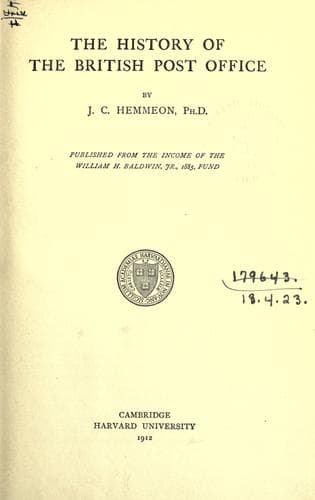
The History of the British Post OfficeHemmeon, Joseph Clarence
History
The History of the British Post Office
Hemmeon, Joseph Clarence
Postal service -- Great Britain -- History
Mr. Scudamore's original estimate of the cost of acquisition of the
telegraphs fell far short of the final expenditure; although it must be
remembered that, when he proposed £2,500,000 as sufficient, he did not
anticipate items of expense which later vastly increased the cost.
Before the committee which reported in 1868 he advanced his original
estimate to £6,000,000, and in the following year to £6,750,000, of
which he considered about two thirds to be of the nature of good-will.
The telegraph companies when first approached asked for twenty-five
years' purchase of their prospective profits, and the Government offered
to buy at the highest price realized on the Stock Exchange up to the
25th of May, with an addition of from 10 to 15 per cent for compulsory
sale. The cost of the leading companies, based upon twenty years'
purchase of the net profits for the year ending 30th June, 1868, was as
follows: For the Electric and International, £2,933,826; for the British
and Irish Magnetic, £1,243,536; for Reuter's, £726,000; for the United
Kingdom Electric, £562,000; and for the Universal Private, £184,421,--a
total of £5,650,047. Separate bargains followed with many smaller
companies. The acts of 1868 and 1869 granted £8,000,000, for the purpose
of purchasing the undertakings of the companies and the interests of the
railways; £6,640,000 were spent in purchases, and £1,560,000 in renewals
and extensions between 1868 and 1872.[807] The claims for compensation
on the part of some of the railways were very excessive. The Lancashire
and Yorkshire Railway asked for £1,129,814, with interest, and £1 per
wire per mile a year for all wires erected upon its right of way by or
for the Post Office. By the terms of the award they obtained £169,197
and 1_s._ per mile per wire. The Great Eastern Railway presented a claim
for £412,608, with interest, and £1 per mile per wire. Their claim was
reduced to £73,315 and an annual payment of £200 for way-leave. In all,
the capital sum of £10,880,571 was expended by the Government,
necessitating an annual interest payment of £326,417, charged, not on
the Post Office vote, but on the Consolidated Fund.[808]
[807] _Rep. Com._, 1867-68, xi, 435, p. 162; 1868-69, vi, 348, p. 11;
1867-68, xi, 435, p. 217; 1873, xxxix, 316, pp. 762-64; 1873, vii, 290,
p. 95; _Parl. Deb._, 3d ser., cxcii, coll. 747-751, 1303-04. According
to figures furnished by Mr. Fowler in a speech in the House of Commons
in 1868, the value of the capital and the debentures of the Electric and
International at that time was £1,240,000 while the capital value of the
British and Irish Magnetic was £534,000; of Reuter's Company, £266,000;
of the United Kingdom Electric, £350,000, and of the London and
Provincial, £65,000 (_Parl. Deb._ 3d ser., cxcv, coll. 747-751).
[808] _Rep. P. G._, 1876, p. 10; _ibid._, 1883, p. 9.
Public-domain text, read in full here on John Shaqi.
Reviews
Reviews
No reviews yet
Be the first to share your thoughts on this work.
Elsewhere in the archive
Join the Discussion
Join the discussion
Sign in to leave a comment or review.
Sign InorCreate an account