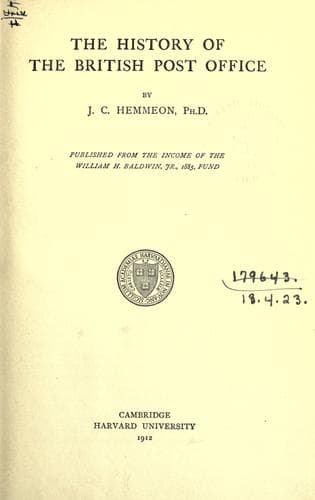
The History of the British Post OfficeHemmeon, Joseph Clarence
History
The History of the British Post Office
Hemmeon, Joseph Clarence
Postal service -- Great Britain -- History
Mr. Forbes, the chairman of the National Telephone Company, said to the
Committee of 1892: "I am prepared to concede that the telephone company
which conducts about 93 or 94 per cent of the whole telephonic business
of the country conducts a great deal of it monstrously badly, but it is
not their fault, it is the fault of Parliament"; and again in referring
to the lack of way-leave power: "Take London for instance; London is
very badly served, but why is it very badly served? Because everything
depends upon the caprice of the individual." As a result of the
complaints that the telephone system was giving an inadequate service
because of the high rates on an inflated capital, because the utility of
the telephones was impaired in that they could not be used in connection
with the telegraph and postal services, and because of the lack of
powers to erect poles in the streets or to lay underground wires or to
connect their exchanges by trunk lines, the Government announced a
change of policy in 1892.[829] This change was set forth in a Treasury
Minute of the 23d of May, 1892, and in two memoranda of agreement of the
same year to which the National and the New Companies were respectively
parties, the arrangements being sanctioned by Parliament in the
Telegraph acts of 1892 and 1896. So far as it affected the National
Company the arrangement was embodied in detail in an agreement dated the
25th of March, 1896, no similar agreement being made with the New
Company because that company went into liquidation in 1892, and in 1896
surrendered its licence. By the agreement of 1896 the National Telephone
Company surrendered its previous licence except for certain definite
districts called "Exchange Areas," a large number of which were
specified in the agreement. These areas were as a rule coterminous with
the urban districts, but comprised in addition certain areas made up of
two or more urban districts together with the intervening country. Power
was reserved to the Postmaster-General to specify other exchange areas,
the understanding being, both with regard to areas already specified and
those to be specified, that industrial areas of wide extent should be
recognized in cases where there were no considerable towns forming
centres of business, that neighbouring towns intimately connected in
their business relations should be placed in the same area, and that
small towns and villages should also be so grouped when each by itself
would not pay. Outside these areas the Postmaster-General alone was
entitled to carry on telephone business, no more licences being granted
for the whole Kingdom, and for any particular town only with the
approval of the corporation or municipal authority. Call offices for the
use of the public were to be opened at the company's exchanges and
connected with the post offices in order that exchange subscribers might
telephone over the trunk lines to exchange subscribers in other towns.
Public-domain text, read in full here on John Shaqi.
Reviews
Reviews
No reviews yet
Be the first to share your thoughts on this work.
Elsewhere in the archive
Join the Discussion
Join the discussion
Sign in to leave a comment or review.
Sign InorCreate an account