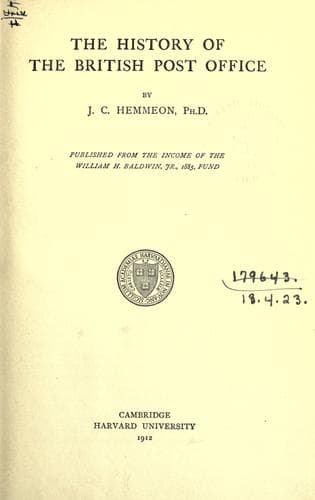
The History of the British Post OfficeHemmeon, Joseph Clarence
History
The History of the British Post Office
Hemmeon, Joseph Clarence
Postal service -- Great Britain -- History
In 1898, another committee was appointed with Mr. Hanbury as chairman,
"to enquire and report whether the telephone service was calculated to
become of such general benefit as to justify its being undertaken by
municipal and other authorities, regard being had to local finance." The
committee were of the opinion that the existing telephone system was not
of general benefit either in the kingdom at large or in those portions
where exchanges existed, that it could hardly be of benefit so long as
monopolistic conditions existed, and that it was capable of becoming
much more useful if worked solely or mainly with a view to the public
interest. They condemned the flat rate subscription charge of the
company as of benefit only to the wealthier commercial classes in
English cities. They commented unfavourably upon the fact that in the
London area there were only 237 call offices open to non-subscribers,
and that as a rule messages could not be sent from them to subscribers
except when the sender and recipient were in the same postal district
or town, when the message might be delivered. They were of the opinion
that the telephones were far more useful in other countries where the
conditions were not so favourable. Conditions, they thought, were
unlikely to improve under the present management. The company must pay
dividends on an inflated capital; its licence would expire in 1911, and
the Government was hardly likely to pay the company at that date for
goodwill. In addition, there were no restrictions on charges, the
company had a motive for limiting its subscribers, as expenses increased
proportionately with an increase in their number, and the question of
way-leaves was a source of great difficulty. Finally, they declared in
favour of competition by the municipalities and the Post Office as
tending to reduce rates, extend the system, and, if the Government
should eventually purchase the telephones, give alternative systems to
choose from. The Government adopted the committee's report, and, in a
Treasury Minute of the 8th of May, 1899, laid down the principles upon
which licences should be granted by the Postmaster-General to the
municipalities, and announced that in London the Postmaster-General
would himself establish an exchange system.[833]
[833] _Rep. Com._, 1898, xii, 383, pp. iii-xiii.
Public-domain text, read in full here on John Shaqi.
Reviews
Reviews
No reviews yet
Be the first to share your thoughts on this work.
Elsewhere in the archive
Join the Discussion
Join the discussion
Sign in to leave a comment or review.
Sign InorCreate an account