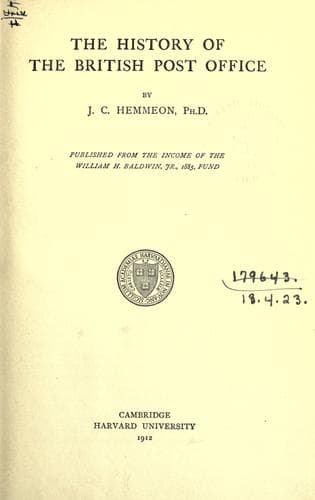
The History of the British Post OfficeHemmeon, Joseph Clarence
History
The History of the British Post Office
Hemmeon, Joseph Clarence
Postal service -- Great Britain -- History
In the meantime the National Telephone Company had been experiencing
considerable difficulty in getting permission to lay underground wires
in London. In 1892, the Telegraph act of that year authorized the
Postmaster-General to grant to his licencees the same way-leave powers
which he enjoyed, subject to the conditions that the licencees should
not exercise such powers in London without the consent of the County
Council, nor in any urban district outside London without the consent of
the urban authority, nor elsewhere without the consent of the County
Council. In pursuance of this authority the Postmaster-General, in the
agreement of the 25th of March, 1896, undertook, at the request of the
company, to authorize them to exercise his way-leave powers in any
exchange area. The company did not apply for the exercise of such
authority in London, but an attempt was made by them to obtain the
consent of the London County Council to allow their wires to be placed
underground, and the work proceeded with the permission of the local
road authorities in London. Negotiations with the council were
fruitless, largely on account of the price asked for way-leave and the
demand for lower rates. The Postmaster-General was advised that it was
his duty to see that the act of 1892 was enforced, and the resulting
correspondence with the company having failed of any satisfactory
result, an information in the name of the Attorney-General was filed
against the company, asking for a declaration that they were not
entitled to proceed with their underground works in London without the
authority of the Postmaster-General and the consent of the County
Council. An order to that effect was made on the 24th of July, 1900.
This seemed a favourable opportunity for the Postmaster-General to
secure from the company certain concessions with reference to their
London exchange system as well as privileges for the subscribers of the
postal exchanges which had been established in London and an agreement
with reference to the purchase in 1911 by the Post Office of the
company's London exchanges. These concessions and privileges were
finally embodied in an agreement made on the 18th of November, 1901, by
which the Postmaster-General agreed to furnish such underground wires on
the demand of the company as he might think reasonable and likely to be
useful to the Post Office later, as well as underground wires connecting
the exchanges of the Post Office with those of the company. When the
subscribers of the London Postal Exchanges exceeded 10,000 in number,
the company agreed to pay half of the rent of the latter wires. No
terminal charges were payable for a message passing over these wires, or
for a message over the trunk lines between the subscribers of the Post
Office in London and those outside London, or between subscribers of the
company in London and those outside London. In addition, the
Postmaster-General promised to afford to the company's subscribers in
Public-domain text, read in full here on John Shaqi.
Reviews
Reviews
No reviews yet
Be the first to share your thoughts on this work.
Elsewhere in the archive
Join the Discussion
Join the discussion
Sign in to leave a comment or review.
Sign InorCreate an account