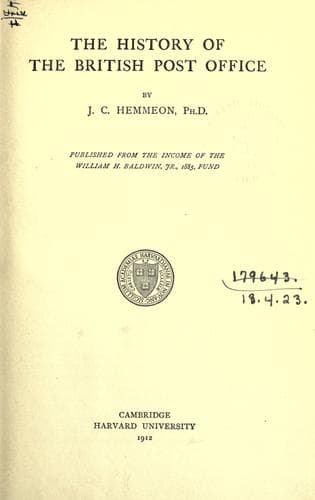
The History of the British Post OfficeHemmeon, Joseph Clarence
History
The History of the British Post Office
Hemmeon, Joseph Clarence
Postal service -- Great Britain -- History
The Council of State gave directions in 1652 for roads to be manned
between Dover and Portsmouth, Portsmouth and Salisbury, London and
Yarmouth, and London and Carlisle through Lancaster.[384] Hitherto,
Carlisle had to depend upon a branch post from the great North Road.
Dover and Portsmouth had no direct connection nor had Bristol and
Exeter, but letters between these places passed through London. These
orders formed part of the directions given to the farmer of the posts in
the following year.[385] Cromwell seems to have recognized the
impracticability of enforcing the speed limit ordered by Elizabeth in
the case of the ordinary mails. He issued orders that in future only
public despatches or letters from and to certain high officials should
be sent by express, and such despatches and letters must be carried at a
speed of seven miles an hour from the first of April to the thirtieth of
September, and five miles an hour the rest of the year.[386]
[384] _Ibid._, 1652-53, p. 312.
[385] _Cal. S. P. D._, 1652-53, p. 449.
[386] _Ibid._, 1655, pp. 285-86.
Toward the close of the seventeenth century, more attention was directed
to the slowness of the posts and the delays along the road. The average
speed on the great roads varied from three to four miles an hour,
anything below three miles generally calling for reproof. For instance,
the posts on the Portsmouth road were reprimanded for travelling only
twenty-two miles in ten hours.[387] It was said that it took the
Yarmouth mail sixty-six hours to travel less than one hundred miles. The
post labels were an important check upon the postmaster's carelessness.
Each postmaster was supposed to mark the time that he received the mail
on a label attached to it for that purpose. In this way no postmaster
marked the speed that his own postboy made and each was a check upon his
neighbour.[388] Lord Arlington gave orders in 1666 for this practice to
be enforced more strictly. In addition to marking the time of arrival,
the time of departure was also to be added.[389] A year later a further
improvement was made by the use of printed labels, containing also
directions as to speed. The names of the post towns through which the
mail must pass were also added, and blanks were left for the postmasters
to fill in the hours of arrival and departure.[390]
[387] _Ibid._, 1661-62, p. 385.
[388] _Ibid._, 1665-66, p. 19.
[389] _Ibid._, 1666-67, p. 384.
[390] _Ibid._, 1667-68, p. 116. From copies of these labels made out in
1666 and 1667 we know exactly how long it took to convey the mails
between London and the important cities of the kingdom although the time
varied more or less at different trips and different seasons.
Public-domain text, read in full here on John Shaqi.
Reviews
Reviews
No reviews yet
Be the first to share your thoughts on this work.
Elsewhere in the archive
Join the Discussion
Join the discussion
Sign in to leave a comment or review.
Sign InorCreate an account