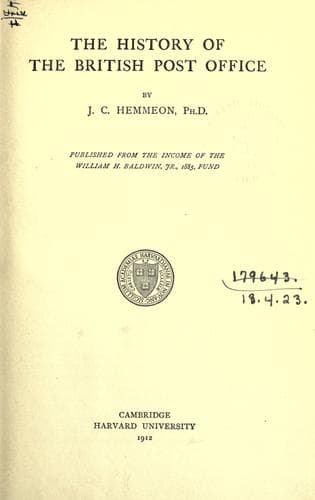
The History of the British Post OfficeHemmeon, Joseph Clarence
History
The History of the British Post Office
Hemmeon, Joseph Clarence
Postal service -- Great Britain -- History
In 1696, the Postmaster-General reported favourably on the establishment
of a cross post road between Bristol and Exeter.[398] The report was
approved, and two years later Bristol and Exeter had direct postal
communication. Colonial and foreign letters for Bristol, after their
arrival in Falmouth, still went via London.[399] Towns adjacent to
Bristol and Exeter, which might have been connected with the cross post,
remained separated. For example, the post went from London through
Cirencester to Wotton-under-Edge, which was within fourteen miles of
Bristol, yet letters from Cirencester to Exeter went via London.[400]
The Exeter-Bristol cross post proved a success. After it had been in
operation three years, it produced over £350 net profits a year. The use
of cross posts was advocated as leading to the conveyance of a larger
number of letters, and private individuals started to establish
them.[401] In 1700, the post road from Exeter to Bristol was continued
to Chester through Worcester and Shrewsbury.[402] Three years later, a
direct road was ordered between Exeter and Truro, but it seems to have
been discontinued after one year's trial.[403]
[398] _Ibid._, 1657-96, p. 55.
[399] Latimer, _Annals of Bristol_, p. 488.
[400] _Cal. T. P._, 1697-1702, pp. 21-22.
[401] _Ibid._, 1697-1702, p. 56.
[402] _Ibid._, 1702-07, p. 26.
[403] _Ibid._, 1702-07, p. 134.
The post roads throughout the kingdom had not been measured correctly. A
mile on the London-Edinburgh road was fully ten furlongs. This had
resulted in a decreased revenue from post horses and often unjustifiable
reprimands for slowness. By a provision in the act of 1711, it was
ordered that all the post roads in the kingdom should be measured. This
was to be done by officials appointed by the Postmaster-General and the
measurements left in the general offices in London, Edinburgh, and
Dublin.[404]
[404] 9 Anne, c. 11.
As the seventeenth century had seen the extension of roads in the
southern and eastern counties of England, so the eighteenth century was
marked by the establishment of posts in those parts of the kingdom most
affected by the industrial revolution. The country about Birmingham,
Kidderminster, and Worcester was to share in the better postal
facilities offered by the mail coaches. Lancashire and the West Riding
of York were not debarred from the use of Palmer's innovation. This was
especially the case in Liverpool, Manchester, Newcastle, Halifax, and
Leeds, for where industrial expansion paved the way, the coaches were
sure to follow.
Public-domain text, read in full here on John Shaqi.
Reviews
Reviews
No reviews yet
Be the first to share your thoughts on this work.
Elsewhere in the archive
Join the Discussion
Join the discussion
Sign in to leave a comment or review.
Sign InorCreate an account