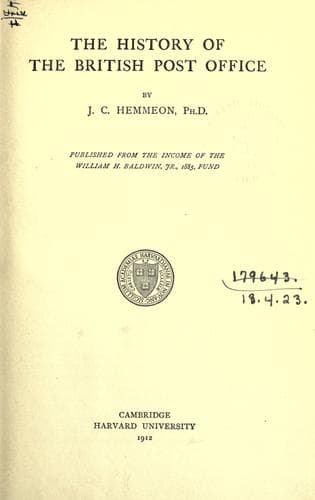
The History of the British Post OfficeHemmeon, Joseph Clarence
History
The History of the British Post Office
Hemmeon, Joseph Clarence
Postal service -- Great Britain -- History
At the beginning of the nineteenth century the roads in Ireland were
attracting considerable attention, and it was the slow speed made by the
mail carts there which was a primary cause in producing any improvement.
The Postmasters-General were directed to cause surveys to be made and
maps drawn of those roads in Ireland over which the mail passed. The
roads were to be levelled so that the ascent or descent should be no
more than one foot in thirty-five wherever this was practicable, the
expense to be borne by the county or barony.[405] This was in 1805, and
the next year the Grand Jury was given the power to call for another
survey, and the surveyor whom they appointed was to decide as to the
necessity for a change in the direction of the road. Copies of all Grand
Jury presentments were to be made to the Postmasters-General.[406] In
1813 the Grand Juries were empowered to present for damages accruing to
owners and occupiers of land, such damages to be raised by the county
and advanced from the consolidated fund.[407]
[405] 45 Geo. III, c. 43.
[406] 46 Geo. III, c. 134.
[407] 53 Geo. III, c. 146.
After 1817, the Postmasters-General were able to report a considerable
acceleration in the speed at which the mails were carried. This was
owing largely to the introduction of a lighter and more improved type of
mail coach, and after 1821 the use of steam packet boats in the case of
the transportation of the Irish and continental mails. Letters leaving
London at 8 P.M. on Tuesday for Ireland had not been delivered in Dublin
until 10 A.M. on Friday. In 1817 they arrived on Thursday in time for
delivery on that day.[408] In 1828, the coaches travelled from London to
Holyhead, a distance of 261 miles, in twenty-nine hours and seventeen
minutes. Four years later the time had been reduced to twenty-eight
hours.[409] By the introduction of one of the patent mail coaches on the
Yarmouth road, the inhabitants of that town were enabled to answer their
letters a day earlier. The coach left London at the usual time (8 P.M.),
arriving in Yarmouth at 11.40 A.M., returning at 3 P.M. on the same
day.[410] The mails to Manchester and Liverpool travelled at the rate of
nine miles an hour over the greater part of the road.[411] The average
speed varied from eight to nine miles an hour. To give the exact
figures, the highest speed attained in England was ten miles and five
furlongs an hour, the slowest six miles, and the average eight miles and
seven furlongs.[412] In Ireland the highest speed attained by the mail
coaches was nine miles and one furlong an hour, the slowest speed six
miles and seven furlongs, and the average eight miles and two
furlongs.[413] Mail carts drawn by two horses were also used largely in
Ireland for the conveyance of the mails, and by these the speed was not
so great. The highest speed made by them was seven miles and five
furlongs an hour, the slowest five miles and one furlong, and the
Public-domain text, read in full here on John Shaqi.
Reviews
Reviews
No reviews yet
Be the first to share your thoughts on this work.
Elsewhere in the archive
Join the Discussion
Join the discussion
Sign in to leave a comment or review.
Sign InorCreate an account