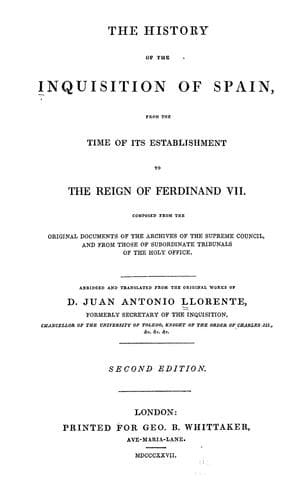
The History of the Inquisition of Spain from the Time of its Establishment to the Reign of Ferdinand VII.Llorente, Juan Antonio
History
The History of the Inquisition of Spain from the Time of its Establishment to the Reign of Ferdinand VII.
Llorente, Juan Antonio
Inquisition -- Spain
This bull was not necessary in Spain, as the Inquisition of Aragon had
taken cognizance of magic and sorcery, since the pontificate of John
XXII.
It appears that the Inquisition of Calahorra, burnt more than thirty
women as sorceresses and magicians in the year 1507. In 1527, a great
number of women who practised magic were discovered in Navarre.
These crimes increased so much in the province of Biscay, that Charles
V. found it necessary to notice it. Persuaded that the ignorance in
which the people were left by the priests was the cause of these
superstitions, he wrote in December, 1527, to the Bishop of Calahorra,
and to the provincials of the Dominicans and Franciscans, to select a
number of able preachers from their communities, to teach the doctrine
of the Christian religion on this point. But these ministers of the
gospel, even those who had acquired a reputation for learning, believed
as well as the enchanters in these illusions.
Nevertheless, Father Martin de Castañaga, a Franciscan monk, composed in
that time, a book in Spanish, entitled, _A Treatise on Superstitions
and Enchantments_. I have read this work, and I acknowledge (with the
exception of a few articles, in which the author appears too credulous,)
that it would be difficult even in the present time to write with more
moderation or discernment. The Bishop of Calahorra, Don Alphonso de
Castilla, having read this treatise, had it printed in quarto, and sent
it to the priests in his diocese, with a pastoral letter, in 1529.
The Inquisition of Saragossa condemned several sorceresses who had
formed part of the association in Navarre, or had been sent into Aragon
to gain disciples. The inquisitors, the ordinary, and the consulters,
were not of the same opinion; the greatest number voted for the
execution of the sorceresses, the others for reconciliation and
perpetual imprisonment. The minority gave up their opinion in deference
to the greater number, and thus relaxation was pronounced unanimously,
without any of the formalities prescribed, and the unfortunate women
perished in the flames. The _Supreme_ Council which was informed of this
event by one of its members, who had learnt it from an inquisitor of
Saragossa, addressed a circular on the 23rd of March, 1536, to all the
tribunals, stating the Inquisition of Saragossa had failed in its duty,
in not having consulted the council, after having found that the
opinions of its members were different.
The inquisitor-general Manrique, being informed that the sect of
sorcerers made great progress in different parts of the Peninsula, added
several articles to the edict of denunciation: the substance of them
was, that all Christians were obliged to declare to the Inquisition:
Public-domain text, read in full here on John Shaqi.
Reviews
Reviews
No reviews yet
Be the first to share your thoughts on this work.
Elsewhere in the archive
Join the Discussion
Join the discussion
Sign in to leave a comment or review.
Sign InorCreate an account