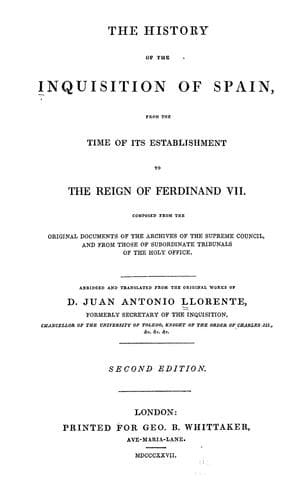
The History of the Inquisition of Spain from the Time of its Establishment to the Reign of Ferdinand VII.Llorente, Juan Antonio
History
The History of the Inquisition of Spain from the Time of its Establishment to the Reign of Ferdinand VII.
Llorente, Juan Antonio
Inquisition -- Spain
The decree most contrary to the wisdom which ought to have animated the
council, was that of the 7th of December, 1532, in which it was ordained
that each provincial Inquisition should state the number and rank of the
persons condemned to different punishments within their jurisdictions,
since their establishment, and to deposit in the churches those
_San-benitos_ which had not been placed there, without even excepting
those of persons who had confessed and suffered their punishment during
the term of grace. This direction was executed with a severity worthy of
the Inquisition; at Toledo those San-benitos were renewed which had been
destroyed by time, and they were likewise sent to the parishes of the
condemned persons. The consequences of these proceedings were the ruin
and extinction of many families, as the children could not establish
themselves according to the rank they had possessed; while the
condemnation of their ancestors by the Inquisition remained unknown. The
council discovered too late the injustice it had committed in respect to
the _San-benito_ since it revoked the decree seven years after, in 1539.
It is not necessary to give the history of the quarrels which took place
between the Inquisition and the different civil authorities, during the
administration of Manrique. A scandalous enterprise of the Supreme
Council ought nevertheless to be mentioned. In 1531, it presumed to
condemn the president of the royal court of appeals, in Majorca, to ask
pardon of the holy office, to attend mass (as a penitent), with a wax
taper in his hand, and to receive the absolution of censures, for having
defended the jurisdiction of the criminal tribunal in an affair which
involved several persons, among whom was one Gabriel Nebel, a servant of
the summoner of the holy office.
CHAPTER XV.
PROSECUTIONS OF SORCERERS, MAGICIANS, ENCHANTERS, NECROMANCERS, AND
OTHERS.
Under the administration of the inquisitor-general, Manrique, the
Inquisition was particularly occupied by the sect of sorcerers.
Pope Adrian VI. (who had been inquisitor-general in Spain), published a
bull on the 20th July, 1523, in which he says, that in the time of his
predecessor Julius II. a numerous sect had been discovered in Lombardy,
which abjured the Christian faith, and abused the ceremonies of religion
and the eucharist. These sectarians acknowledged the devil as their
patron, and promised obedience to him.
They sent maladies to animals and destroyed the fruits of the earth by
their enchantments. An inquisitor having attempted to arrest and bring
them to punishment, the ecclesiastical and secular judges opposed him,
which led Julius II. to declare that these crimes were within the
jurisdiction of the Inquisition, as well as all other heresies. In
consequence Adrian VI. reminded the different Inquisitions of their duty
in this respect.
Public-domain text, read in full here on John Shaqi.
Reviews
Reviews
No reviews yet
Be the first to share your thoughts on this work.
Elsewhere in the archive
Join the Discussion
Join the discussion
Sign in to leave a comment or review.
Sign InorCreate an account