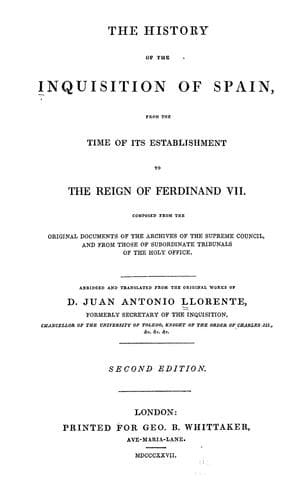
The History of the Inquisition of Spain from the Time of its Establishment to the Reign of Ferdinand VII.Llorente, Juan Antonio
History
The History of the Inquisition of Spain from the Time of its Establishment to the Reign of Ferdinand VII.
Llorente, Juan Antonio
Inquisition -- Spain
OF THE TRIAL OF THE FALSE NUNCIO OF PORTUGAL, AND OTHER IMPORTANT EVENTS
DURING THE TIME OF CARDINAL TABERA, SIXTH INQUISITOR-GENERAL.
_Quarrels of the Inquisition with the Court of Rome._
Charles V. appointed Cardinal Don Juan Pardo de Tabera, Archbishop of
Toledo, to succeed Cardinal Manrique, in the office of
inquisitor-general; his bulls of institution were expedited in September
1539, and a month after he entered upon his office, so that the
_Supreme_ Council governed the Inquisition for the space of one year.
It was under the inquisitor Tabera, that the congregation of the holy
office was founded at Rome, on the 1st of April, 1543. It gave the title
and privilege of inquisitors-general of the faith, for all the Christian
world, to several cardinals; two of the number were Spaniards, Don Juan
Alvarez de Toledo, Bishop of Burgos, a son of the Duke of Alva, and Don
Thomas Badia, cardinal-priest of the title of St. Silvestre, and master
of the sacred palace. These two cardinals were of the order of St.
Dominic.
This new creation alarmed the Inquisition of Spain for its supremacy;
but the Pope formally declared that it was not his intention to alter
anything that had been established, and the institution of the
inquisitors-general would not interfere with the privileges of the other
inquisitors. Yet the general Inquisition attempted several times to give
laws to that of Spain, particularly in the prohibition of some writings
which had been proscribed at Rome. The inquisitors-general wrote to
those of Spain, to register the censure of the theologians, because they
were to be looked upon as the most learned of the Catholic church, and
because their opinion was supported by the confirmation of the supreme
head of the church, whom the cardinals asserted to be infallible when he
acted (as in this case) as sovereign pontiff. He approved and commanded
the decrees of the congregation of cardinals, to be received and
executed with submission.
These pretensions of the Court of Rome did not inspire the inquisitors
of Spain with any awe; they have always defended their privileges with
so much vigour, that they often refused to execute the apostolical
briefs, when they were contrary to the decisions they had made
conjointly with the _Supreme_ Council. We find examples of this
resistance under Urban VIII., in the condemnation of the works of the
Jesuit, John Baptist Poza, which had been pronounced at Rome; and under
Benedict XIV., when the inquisitor-general, Don Francis Perezdel Prado,
Bishop of Teruel, refused to enter upon the _prohibitory index_ the
works of Cardinal Noris, in opposition to the request, and even the
formal demand, of that great Pope.
Public-domain text, read in full here on John Shaqi.
Reviews
Reviews
No reviews yet
Be the first to share your thoughts on this work.
Elsewhere in the archive
Join the Discussion
Join the discussion
Sign in to leave a comment or review.
Sign InorCreate an account