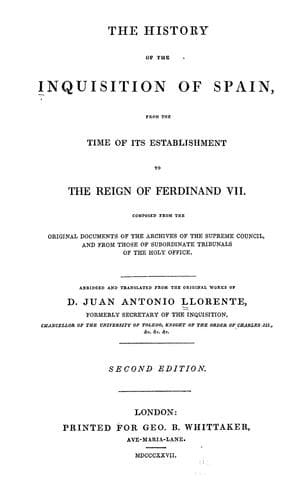
The History of the Inquisition of Spain from the Time of its Establishment to the Reign of Ferdinand VII.Llorente, Juan Antonio
History
The History of the Inquisition of Spain from the Time of its Establishment to the Reign of Ferdinand VII.
Llorente, Juan Antonio
Inquisition -- Spain
The number of victims, calculated as it was for the time of Manrique,
affords, for the seven years of Cardinal Tabera's ministry, seven
thousand seven hundred and twenty individuals condemned and punished;
eight hundred and forty were burnt in person, four hundred and twenty in
effigy; the rest, in number five thousand, four hundred, and sixty, were
subjected to different penances. I firmly believe that the number was
much more considerable; but faithful to my system of impartiality, I
have stated the most moderate calculation.
CHAPTER XVII.
OF THE INQUISITIONS OF NAPLES, SICILY, AND MALTA, AND OF THE EVENTS OF
THE TIME OF CARDINAL LOAISA, SEVENTH INQUISITOR-GENERAL.
_Naples._
Charles V. appointed, to succeed Cardinal Pardo de Tabera, Cardinal Don
Garcia de Loaisa, Archbishop of Seville, who was the seventh
inquisitor-general. This prelate had arrived at a great age, since he
had signed different ordinances of the Supreme Council in 1517. He had
been the confessor of Charles V., prior-general of the order of St.
Dominic, Bishop of Osma and Siguenza, and apostolical commissary of the
Holy Crusade. The Court of Rome expedited his bulls of confirmation on
the 18th of February, 1546, and he died on the 22nd of April, in the
same year.
In 1546, Charles V. resolved to establish the Inquisition at Naples,
although his grandfather had failed in the attempt in 1504 and 1510. He
commissioned his viceroy, Don Pedro de Toledo, Marquis of Villa Franca
del Bierzo, to select inquisitors and officers from among the
inhabitants, to send to the government a list of the persons chosen, and
all the necessary documents, that the inquisitor-general might be able
to delegate the necessary powers to the new inquisitors: when these
measures had been taken, the tribunal was to be established with all the
forms of the inquisitorial jurisdiction.
Frederic Munter, professor of theology in the literary academy at
Copenhagen, has supposed that the intrigues of Don Pedro de Toledo were
the causes of the introduction of the Inquisition; but he was not able
to consult the original documents, which are now in my hands, and this
impossibility was the cause of his errors in his history of the Sicilian
Inquisition.
Public-domain text, read in full here on John Shaqi.
Reviews
Reviews
No reviews yet
Be the first to share your thoughts on this work.
Elsewhere in the archive
Join the Discussion
Join the discussion
Sign in to leave a comment or review.
Sign InorCreate an account