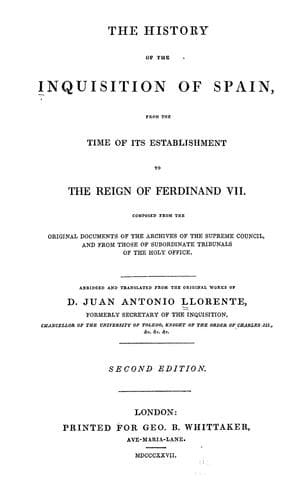
The History of the Inquisition of Spain from the Time of its Establishment to the Reign of Ferdinand VII.Llorente, Juan Antonio
History
The History of the Inquisition of Spain from the Time of its Establishment to the Reign of Ferdinand VII.
Llorente, Juan Antonio
Inquisition -- Spain
The king afterwards represented that the converted Jews abused their
privileges, some returning to Judaism, and others adopting the errors of
the Protestants. This circumstance induced the Pontiff to publish
another bull on the 25th of March, 1536, which is considered as the
foundation of the Inquisition in Portugal. The Pope appointed as
inquisitors, the Bishops of Coïmbra, Lamego, and Ceuta; and decreed at
the same time, that another bishop or priest of the king's nomination
should be associated with them. The Pope granted to each inquisitor the
power of proceeding against heretics and their adherents, in concert
with the diocesan in ordinary, or alone, if he refused to assist; they
were likewise obliged for the first three years, in the proceedings
against heretics, to conform to the manner of proceeding in cases of
theft or homicide, and after that period to the rules of common law; the
practice of confiscation was abolished, and the heirs of the condemned
could inherit as if he died intestate. Lastly, the Pope commanded that a
sufficient number of tribunals should be instituted, for the execution
of these measures[11]. The king appointed Don Diego de Silva, bishop of
Ceuta, first inquisitor-general.
Such was the origin of the Inquisition in Portugal, four years before
Saavedra arrived in that country. In 1539, the Pope appointed Don Henry,
archbishop of Braga, to succeed the first inquisitor-general. The third
grand inquisitor was Don George de Almeida, archbishop of Lisbon.
All that I have now stated is taken from authentic documents. I conclude
from them that Juan Perez de Saavedra forged his brief of cardinal _à
latere_, presented it in December, 1540, and succeeded in concealing his
forgery; that what he related of the Jesuit was not true, or happened
differently; that seeing the Inquisition established in a manner
contrary to his opinions, he insinuated that it would be better to take
that of Spain as a model, which was well known to the inquisitors of
Llerena, and that he would visit the different parts of the kingdom to
facilitate this design; that he travelled through part of the kingdom in
the month of December, and continued his journeys in January in the
following year, when he was arrested, before the court of Lisbon
received information of his imposture. I have no doubt that Saavedra
amassed great sums, but I am far from thinking that they were as
considerable as he affirmed them to be.
Cardinal Tabera, sixth inquisitor-general, died on the 1st of August,
1545: at his death the number of tribunals was the same as when he was
placed at the head of the Inquisition: he had re-established that of
Jaen, but the tribunal of Navarre was united with that of Calahorra.
Public-domain text, read in full here on John Shaqi.
Reviews
Reviews
No reviews yet
Be the first to share your thoughts on this work.
Elsewhere in the archive
Join the Discussion
Join the discussion
Sign in to leave a comment or review.
Sign InorCreate an account