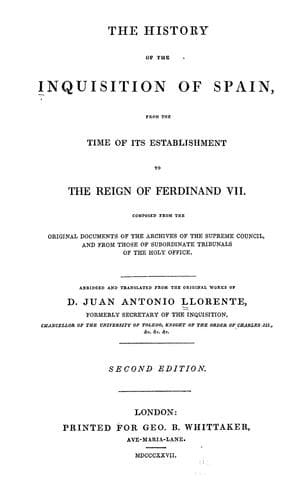
The History of the Inquisition of Spain from the Time of its Establishment to the Reign of Ferdinand VII.Llorente, Juan Antonio
History
The History of the Inquisition of Spain from the Time of its Establishment to the Reign of Ferdinand VII.
Llorente, Juan Antonio
Inquisition -- Spain
An act appeared on the 16th of June, 1546, renewing the former
concessions, and granting new ones. The Inquisition resolved to
celebrate its victory; a solemn _auto-da-fé_ was celebrated, in which
four contumacious persons were burnt in effigy. Similar ceremonies took
place in 1549 and 1551. The inquisitors now became as insolent as
formerly, treated the Sicilians of all classes with so much severity,
that a new sedition was excited in Palermo against the holy office, at
the time when the edict _of the faith_ was about to be published. The
viceroy succeeded in restoring tranquillity, and the inquisitors
appeared more moderate, at least while they were under the influence of
fear, and instead of the solemn _autos-da-fé_ which had caused so much
indignation, satisfied themselves with celebrating them, from time to
time, privately in the hall of the tribunal; but in 1569 they ordained
one which was general, and gave rise to a circumstance which deserves to
be recorded.
Among the prisoners of the Inquisition, was an unfortunate creature who
had inspired the Marchioness of Pescari, the wife of the viceroy, with
some interest. The inquisitors, thinking it necessary to conciliate the
first magistrate of the island, remitted his punishment at the request
of the marchioness, but at the same time informed the inquisitor-general
of the circumstance, to avoid all reproach. The Supreme Council having
deliberated on the affair, addressed a severe reprimand to the
inquisitors, for having assumed a right which they did not possess,
_because, in affairs of that nature, intercession could not be
admitted_.
When the island of Malta belonged to the Spanish monarchy, it was
subject to the Inquisition of Sicily; but when it was given to the
knights of St. John of Jerusalem, it would have been contrary to the
dignity of the grand-master to permit the exercise of foreign
jurisdiction in it, after having received that of ecclesiastical power
from the Pope.
A man was arrested in the island as an heretic, and the Inquisition of
Sicily took informations on the affair. The grand-master wrote to demand
them; the inquisitors consulted the council, which directed them, in
1575, not only to refuse them, but to claim the prisoner. The
grand-master, resolved to defend his privileges, caused the man to be
tried in the island, and he was acquitted. This act displeased the
inquisitors, who, to revenge themselves, took advantage of an occurrence
which took place in the following year.
Public-domain text, read in full here on John Shaqi.
Reviews
Reviews
No reviews yet
Be the first to share your thoughts on this work.
Elsewhere in the archive
Join the Discussion
Join the discussion
Sign in to leave a comment or review.
Sign InorCreate an account