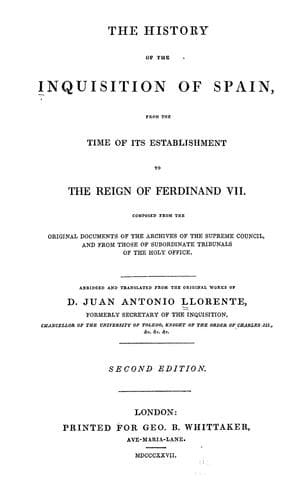
The History of the Inquisition of Spain from the Time of its Establishment to the Reign of Ferdinand VII.Llorente, Juan Antonio
History
The History of the Inquisition of Spain from the Time of its Establishment to the Reign of Ferdinand VII.
Llorente, Juan Antonio
Inquisition -- Spain
Don Pedro de la Roca, a Spaniard, and a knight of Malta, killed the
first alguazil of the Sicilian Inquisition in the city of Messina. He
was arrested and conducted to the secret prisons of the holy office. The
grand-master claimed his knight, as he alone had a right to try him. The
council being consulted, commanded the inquisitors to condemn and punish
the accused as an homicide. The inquisitor-general communicated this
resolution to Philip II., who wrote to the grand-master to terminate the
dispute.
The quarrels between the secular powers and the Inquisition were not
less violent in Sicily: in 1580 and 1597 attempts were made to appease
them, but without success; and in 1606 the Sicilians had the
mortification of seeing their viceroy, the Duke de Frias, constable of
Castile, prosecuted and subjected to their censures.
In 1592 the Duke of Alva, who was then viceroy, endeavoured by indirect
means to repress the insolence of the inquisitors. Perceiving that the
nobility of all classes were enrolled among the _familiars_ of the holy
office, in order to enjoy its privileges, and to keep the people in
greater order, he represented to the king that the power of the
sovereign and the authority of his lieutenant were almost null, and
would be entirely so in time, if these different classes continued to
enjoy privileges which had the effect of neutralizing the measures of
government. Charles II. acknowledged that this state of things was
contrary to the dignity of his crown; and he decreed that no person
employed by the king should possess those prerogatives, even if he was a
_familiar_ or officer of the Inquisition. The people then began to feel
less respect for the tribunal; and this was the commencement of its
decline.
In 1713, Sicily no longer formed a part of the Spanish dominions, and
Charles de Bourbon in 1739 obtained a bull, which created an
inquisitor-general for that country, independent of Spain; and in 1782,
Ferdinand IV., who succeeded Charles, suppressed this odious tribunal.
During the two hundred and seventy-nine years of its existence, the
solemn and general _autos-da-fé_ were celebrated of which Munter speaks,
and several others which were performed in the hall of the tribunal.
In the year 1546, which corresponds with the administration of Cardinal
Loaisa, the number of condemned in the fifteen Spanish tribunals
amounted to seven hundred and eighty individuals.
CHAPTER XVIII.
OF IMPORTANT EVENTS DURING THE FIRST YEARS OF THE ADMINISTRATION OF THE
EIGHTH INQUISITOR-GENERAL; RELIGION OF CHARLES V. DURING THE LAST YEARS
OF HIS LIFE.
_Trials during the first years of the ministry of Valdés._
Public-domain text, read in full here on John Shaqi.
Reviews
Reviews
No reviews yet
Be the first to share your thoughts on this work.
Elsewhere in the archive
Join the Discussion
Join the discussion
Sign in to leave a comment or review.
Sign InorCreate an account