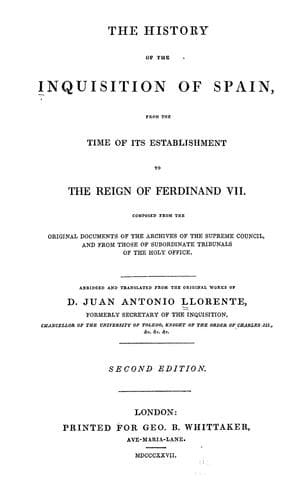
The History of the Inquisition of Spain from the Time of its Establishment to the Reign of Ferdinand VII.Llorente, Juan Antonio
History
The History of the Inquisition of Spain from the Time of its Establishment to the Reign of Ferdinand VII.
Llorente, Juan Antonio
Inquisition -- Spain
It will be necessary here to quote a letter of Don Bartholomew Carranza
to Brother Louis de la Cruz, a Dominican, and his disciple. The
archbishop mentions as a well-known circumstance, that his catechism had
been presented to the holy office; Brother Melchior Cano and Dominic
Soto had been commissioned to censure it, and that they had judged
unfavourably of his work. He complained much of this conduct in Soto; he
said he could not comprehend such scruples _in a man who had been so
indulgent to the Doctor Egidius who was considered as an heretic, while,
on the contrary, the author of the Catechism had combated the opinions
of the heretics of England and Flanders_; that Soto had judged the book
of a Dominican monk no less favourably, while he treated an archbishop,
whom he was bound to respect, without consideration; that he would, in
consequence, write to Rome and Flanders, where he hoped that his
propositions would be more favourably received than at Valladolid; but
that, at all events, Pedro de Soto, confessor to the emperor, would
write to Dominic, and he hoped that the Almighty would allay the tempest
which had been raised around him.
Brother Pedro wrote to Dominic Soto, and a correspondence ensued between
him and the archbishop Carranza, on the censure of the catechism, and
other works. These letters were found among the papers of Carranza, when
he was arrested by the Inquisition. They proved that Dominic Soto had
violated the secrecy which he had sworn to maintain before the
Inquisition: some details were found in them relating to the violence
which had been used to make him condemn the catechism of Carranza; he
was arrested by the Inquisition of Valladolid, on account of these
expressions.
It appears from the archbishop's letter, that the censure of Brother
Dominic on Egidius was mild and conciliating, which does not accord with
the substitution of the false exposition of his principles mentioned by
Gonzales de Montes. I must observe that this author writes like a man
blinded by his hatred of his enemies, whom he calls papists, hypocrites,
and idolaters; he even carries his fanaticism so far as to look upon the
deaths of the three judges of Egidius during his lifetime as a
particular effect of divine justice.
As the affair of Juan Gil is connected with the history of Rodrigo
Valero, I shall here relate it. He was born of a good family in Lebrija.
In his youth, he was extremely irregular and dissipated, but all at once
he quitted society, and shut himself up to study the Scriptures with so
much ardour, that his conversation, and his contempt for food and
clothing, made him pass for a madman.
He endeavoured to persuade priests and monks, that the Roman church was
far from holding the pure doctrine of the Evangelists, and became one of
the sect of Luther. His attachment to their doctrine was so great, that
when he was asked from whom he held his mission, he replied from God
himself through the inspiration of the Holy Spirit.
Public-domain text, read in full here on John Shaqi.
Reviews
Reviews
No reviews yet
Be the first to share your thoughts on this work.
Elsewhere in the archive
Join the Discussion
Join the discussion
Sign in to leave a comment or review.
Sign InorCreate an account