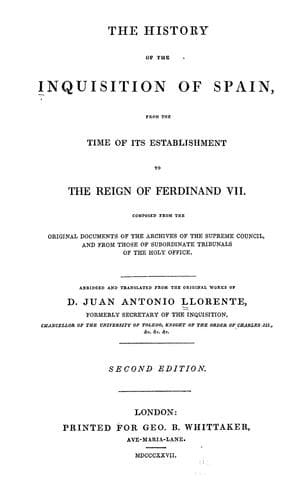
The History of the Inquisition of Spain from the Time of its Establishment to the Reign of Ferdinand VII.Llorente, Juan Antonio
History
The History of the Inquisition of Spain from the Time of its Establishment to the Reign of Ferdinand VII.
Llorente, Juan Antonio
Inquisition -- Spain
The inquisitors being informed of this arrangement, declared that, as
the reputation of a bishop was concerned, it was necessary to convoke a
public assembly, where Dominic Soto should explain the object of the
meeting in a sermon, and read his confession of faith; that Egidius
should afterwards read his, that the assembly might judge of the
conformity of their opinions. The inquisitors caused two pulpits to be
prepared, but, either by chance, or from a private order, they were so
far apart, that Egidius could not hear what Soto said.
Soto[12] read an exposition of his principles entirely different from
that on which they had agreed in their private conferences; and as
Egidius did not hear him, and supposed that he was reading the same
confession which he had approved, he consequently made signs with his
head and hands that be accorded with his propositions. Egidius then
began to read his confession of faith, but those who understood the
subject, soon perceived that there was not the slightest resemblance
between them, and that Egidius held several opinions entirely opposite
to some propositions advanced by Dominic Soto, and acknowledged as
dogmatical by _the tribunal of the faith_: this circumstance effaced the
favourable impressions produced by the gestures of Egidius. The
inquisitors added these writings to those of the trial, and passed
judgment upon Egidius according to the advice of Soto. He was declared
violently suspected of the Lutheran heresy, and condemned to three
years' imprisonment; he was prohibited from preaching, writing, or
explaining theology for the space of ten years, and never to leave the
kingdom on pain of being considered and punished as a formal heretic.
Egidius remained in prison until 1555; he was at first extremely
astonished at his situation, after having perfectly agreed with the
Dominican on all the points in question. He was not undeceived, until
some of his fellow-prisoners informed him of the difference of his
articles with those of Soto, and the treachery of that monk.
Egidius took advantage of the short interval of liberty which followed
his imprisonment to go to Valladolid, where he had an interview with
Doctor Cazalla and other Lutherans in that city: on his return to
Seville he fell sick, and died in 1556. The tribunal being informed of
his intercourse with heretics, instituted another trial, and pronounced
that he died an heretic; his body was disinterred, and burnt with his
effigy, in a solemn _auto-da-fé_, his memory declared infamous, and his
property confiscated: this sentence was executed in 1560.
Public-domain text, read in full here on John Shaqi.
Reviews
Reviews
No reviews yet
Be the first to share your thoughts on this work.
Elsewhere in the archive
Join the Discussion
Join the discussion
Sign in to leave a comment or review.
Sign InorCreate an account