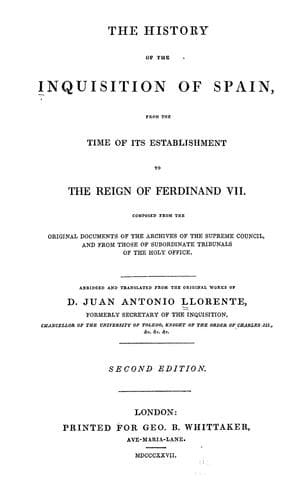
The History of the Inquisition of Spain from the Time of its Establishment to the Reign of Ferdinand VII.Llorente, Juan Antonio
History
The History of the Inquisition of Spain from the Time of its Establishment to the Reign of Ferdinand VII.
Llorente, Juan Antonio
Inquisition -- Spain
Neither Francis Angulo, nor Louis de St. Gregoria were examined, perhaps
they were dead. Francis de Villalba, preacher to the emperor, declared,
that he had not heard anything in the emperor's apartment which was
worthy of being reported to the Inquisition. Being questioned as to what
he thought of the discourse which the archbishop had addressed to the
emperor, he replied that he was only present once, when the prelate
recited some verses of the _De profundis_; that Don Louis d'Avila
afterwards requested him to speak to the emperor, and that he made him
an exhortation. When examined on the subject of the words and the
scandal, he replied that he did not hear or see anything that could
offend him.
Don Louis d'Avila y Zuñiga cited the entrance of the prelate; and that
he took a crucifix and knelt down, saying with a loud voice, _behold him
who answers for all; there is no longer any sin, all is pardoned_. The
witness did not recollect if the archbishop said, _and however numerous
the sins may be, they are all pardoned_: that these words did not appear
proper to him, and he requested the emperor's preacher to make him an
exhortation, who afterwards told him that his majesty appeared
satisfied.
Don Louis de Quixada deposed that the archbishop was with the emperor,
three times before his death, that he saw him take a crucifix, and that
he pronounced some words on the subject of Jesus Christ dying for our
sins, but he could not recollect them, because his employment as
major-domo occupied him at the time.
These circumstances show that Charles V. was far from being inclined to
Lutheranism at his death. It is equally false that the inquisitors took
his will, to examine if it contained any sentiments tending to heresy. I
have read or consulted a multitude of books and papers in the archives
of the Inquisition, and could not discover anything to support the
opinion; so that nothing now remains but to seek the origin of this
fable.
A number of circumstances may have caused the Inquisition to be
mentioned in relating the death of Charles V. The first is, that
Carranza, who attended him at his death, was soon after arrested by the
holy office; the second, that his two preachers, Constantine Ponce and
Augustine Cazalla, were condemned by that tribunal; the third, that his
confessor, Juan de Regla, was obliged to abjure certain propositions;
the fourth, that the emperor himself had been threatened with
excommunication three years before, as a favourer of heretics, by Paul
IV.; the fifth, that Philip II. made use of the Inquisition in a variety
of circumstances entirely political.
Charles V. died a Catholic; and it is only to be regretted that he
associated so many superstitions with his Catholicism, and showed so
much attachment to the Inquisition during his life.
CHAPTER XIX.
Public-domain text, read in full here on John Shaqi.
Reviews
Reviews
No reviews yet
Be the first to share your thoughts on this work.
Elsewhere in the archive
Join the Discussion
Join the discussion
Sign in to leave a comment or review.
Sign InorCreate an account