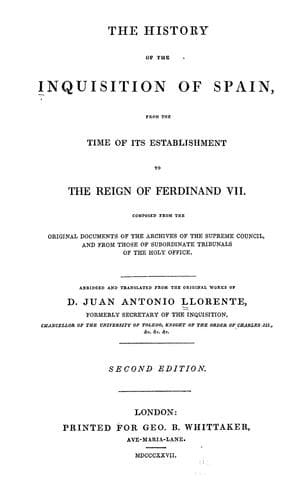
The History of the Inquisition of Spain from the Time of its Establishment to the Reign of Ferdinand VII.Llorente, Juan Antonio
History
The History of the Inquisition of Spain from the Time of its Establishment to the Reign of Ferdinand VII.
Llorente, Juan Antonio
Inquisition -- Spain
OF THE PROCEEDINGS AGAINST CHARLES V. AND PHILIP II.: AS SCHISMATICS AND
FAVOURERS OF HERESY.--PROGRESS OF THE INQUISITION UNDER THE LAST OF
THESE PRINCES.--CONSEQUENCES OF THE PARTICULAR FAVOUR WHICH HE SHOWED
TOWARDS IT.
_Trials of Charles V., Philip II., and the Duke of Alva._
In 1555, John Peter Carafa, a noble Neapolitan, and as such the subject
of Charles V. and Philip II., was elevated to the holy see, under the
name of Paul IV., at the age of seventy-nine years. Charles V. had then
renounced the crown of Sicily, in favour of Prince Philip, who was about
to marry the Queen of England. The new Pope mortally hated the emperor,
not only because he could not bear to be a subject to the house of
Austria, but because this prince and his son favoured the families of
_Colonna_ and _Sforza_, which he looked upon as the rivals of his house.
The kingdom of Naples passed at that time for a fief of the holy see.
Paul IV. undertook to deprive Charles of the imperial purple, and his
son of the crown of Sicily, and to dispose of it in favour of one of his
nephews, with the assistance of the King of France, or to give the
kingdom to some French prince. He commenced the proceedings against
Charles V. and Philip, by the preparatory instruction, to show that they
were enemies of the holy see, particularly in protecting the families of
_Sforza_ and _Colonna_, whose hatred for the Pontiff was well known.
To these reasons it was to be alleged that Charles V. was a favourer of
heretics, and suspected of Lutheranism, since the publication of the
imperial decrees at the diet of Augsburg, in 1554. The fiscal of the
apostolical chamber then demanded that the Pope should declare Charles
V. to be deprived of the imperial crown, and that of Spain and its
dependencies, and Philip of the throne of Naples; that bulls of
excommunication should be issued against them, and the people of
Germany, Spain, Italy, and particularly of Naples, released from their
oath of fidelity. Paul IV. suspended the trial at this stage of the
proceedings, to continue it when he judged it convenient. He revoked at
the same time all the bulls which his predecessors had expedited in
favour of the Spanish monarchs, for the collection of the annual subsidy
imposed on the clergy, and for the funds destined for the _holy
crusade_. The Pope was not content with this hostile measure; he entered
into an alliance with Henry II., King of France, to make war upon the
house of Austria, until its princes were deprived of their kingdoms.
Public-domain text, read in full here on John Shaqi.
Reviews
Reviews
No reviews yet
Be the first to share your thoughts on this work.
Elsewhere in the archive
Join the Discussion
Join the discussion
Sign in to leave a comment or review.
Sign InorCreate an account